Global Times Features Unisound’s “Token Going Global” in Both Its Overseas and Chinese Editions
From model services in Xiamen to cross-border e-commerce livestreams in Ethiopia and product content for American consumers, Chinese AI is entering global business workflows through “token going global.”
Recently, both the overseas and Chinese editions of Global Times covered the development of China’s “token going global” trend. Unisound’s work with a cross-border e-commerce company in Ethiopia featured in both reports. The local team accesses large models hosted in China through APIs, using AI to generate livestream scripts and refine product content. This brings Chinese large-model capabilities across borders and into overseas business operations.
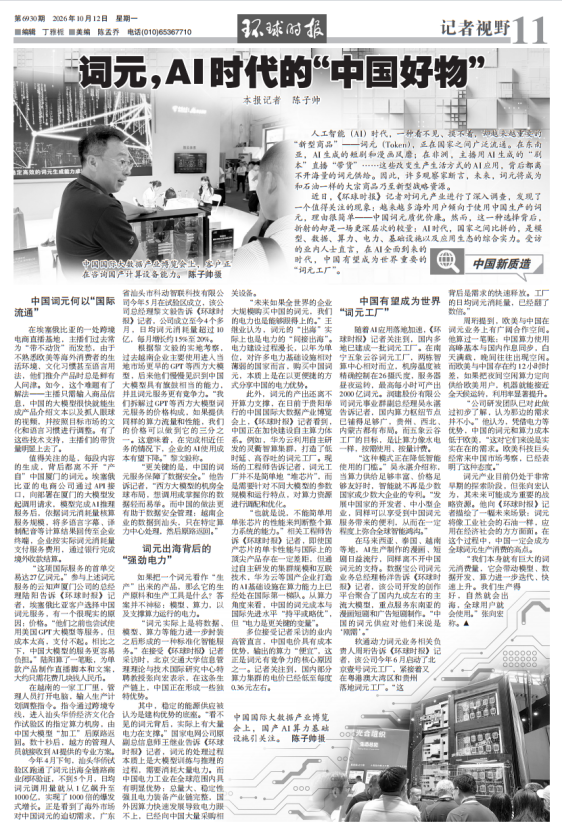
Chinese-language report: “Tokens: China’s Quality Products in the AI Era”
https://hqtime.huanqiu.com/share/article/4TZegIw0Rxb
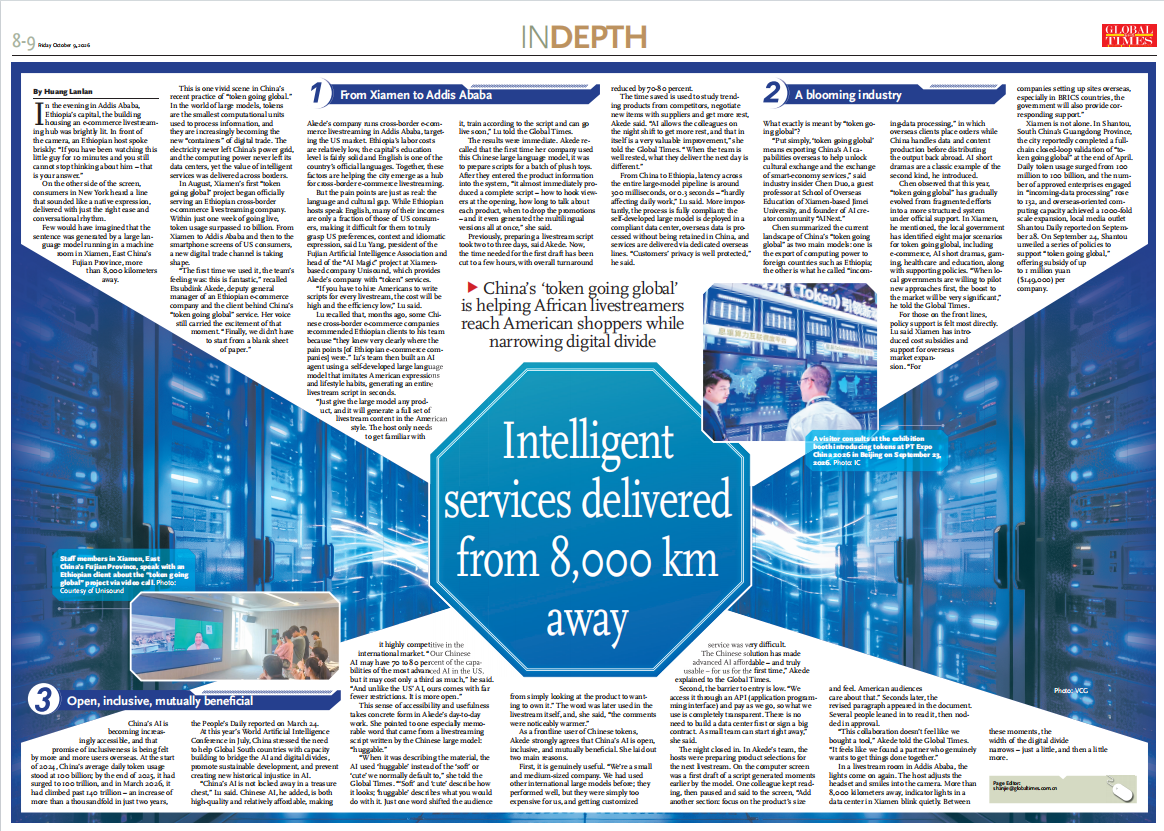
English-language report: “China’s ‘token going global’ is helping African livestreamers reach American shoppers while narrowing digital divide”
https://www.globaltimes.cn/page/202610/1371868.shtml
Behind the successful deployment of these overseas services is the continued validation of large-model capabilities in real-world settings. Models must be able to solve complex tasks to become part of customers’ business workflows and generate sustained usage.
Recently, Unisound’s U2-Flash placed first in four categories and second overall in an industrial-grade coding evaluation. It led the chip RTL, code compilation and migration, vector rendering, and long-horizon agent decision-making categories, demonstrating its capabilities in code generation, engineering delivery, and agent execution for complex industrial tasks.
Continued improvements in model performance are also translating into measurable market growth.
Data shows that U2-Flash’s token consumption has risen in steps since its release on September 15. Daily consumption on October 11 reached nearly 30 times the level recorded on launch day.
From practical applications by overseas customers to rapid growth in platform usage, these developments illustrate how Unisound is moving its large-model capabilities from technical validation into commercial use. U2-Flash’s performance enables it to serve real-world business scenarios globally and meet specific customer needs. At the same time, standardized services lower barriers to model integration, helping more developers and enterprises incorporate AI into their workflows.
Token Going Global: Bringing Chinese Large Models into Global Business Operations
The key to this trend is whether model capabilities can stand up to real-world business demands. A token is a basic unit used by large models to process information such as text, and an important basis for metering and billing model services. Under the “token going global” model, overseas companies access Chinese large-model services through APIs, obtain capabilities on demand, and pay according to actual usage.
The report “Tokens: China’s Quality Products in the AI Era” examines how tokens produced in China are reaching overseas applications through model services. The Ethiopian cross-border e-commerce project supported by Unisound is a concrete example of this trend.
The local livestreaming team needs to create promotional product content for American consumers, but faces challenges in preparing and localizing content to suit the target market’s cultural conventions, language, and marketing practices. To address these needs, Unisound built an agent application powered by its proprietary U2-Flash large model, delivering content support such as livestream scripts through model services.
According to project data, the first transaction for this international service totaled 2.7 billion tokens. Producing a livestream script and promotional copy for a single product costs only a few yuan.
This application demonstrates the business value behind tokens as a unit of AI service consumption. Model capabilities extend beyond technical demonstrations: overseas customers can access them on demand through standardized interfaces and apply them to specific tasks such as content production.
For overseas enterprises, this offers a more flexible way to access AI capabilities. For Chinese AI companies, it opens a broader path to serving global businesses—from providing technology to delivering services, and from model capabilities to practical applications.
From a Word to a Script: Testing Model Value in Real Business Workflows
The report “China’s ‘token going global’ is helping African livestreamers reach American shoppers while narrowing digital divide” provides further details of the project’s use, showing how AI is being integrated into cross-border e-commerce.
To meet the local customer’s livestream content production needs, the Unisound team built an agent application based on its proprietary large model. After the customer enters product information, the system generates livestream scripts covering opening introductions, product selling points, and promotional arrangements. It also supports multilingual content generation, helping prepare content for different markets.
According to the customer, livestream scripts that previously took two to three days to prepare can now be drafted within a few hours, shortening the overall delivery cycle by 70–80%.
The report also highlights a small but telling detail: when describing a plush toy, the model used the word “huggable,” shifting the focus from appearance alone to the experience of embracing the product. After using this wording in an actual livestream, the customer observed more positive feedback in the comments.
This detail shows that content generation for real commercial settings requires more than turning product information into text. It must account for the target audience, usage context, and communication preferences to produce content that better meets business needs.
From entering product information and generating scripts to using the content in live broadcasts, the value of models and agents emerges within concrete workflows: they help customers shorten preparation time, reduce production costs, and adapt content across languages and cultures.
For large models, real business operations are also an important testing ground. Whether generated content is usable, task efficiency improves, and results can be incorporated into actual workflows are all important measures of practical value.
Sustained Token Growth Signals Positive Market Feedback for U2-Flash
While the overseas project demonstrates the cross-border application of Chinese large-model services, growth in U2-Flash usage since launch offers another perspective on the market’s response to Unisound’s model services.
Behind the nearly 30-fold increase in daily usage is an ongoing process of aligning model capabilities, product services, and user needs. When choosing a model, developers and enterprises consider not only capability but also response speed, usage cost, and suitability for their tasks. Technical capabilities are more likely to translate into sustained use when a model meets actual task requirements and integrates easily into existing workflows.
Designed for tasks such as agent operations and coding, U2-Flash seeks to balance model capability, response speed, and usage cost. Through standardized interfaces, Unisound’s Model-as-a-Service (MaaS) platform provides developers and enterprises with access to its models, helping them incorporate large-model capabilities into existing applications and workflows.
U2-Flash’s progress from launch to rapid usage growth reflects the market’s initial response to the platform and provides a basis for further product optimization and expansion into new use cases. As more users join, the fit between model capabilities and actual task requirements will be an important factor in driving continued usage.
From Model Capability to Practical Use: Expanding the Value of AI Services
An Ethiopian cross-border e-commerce team using a Chinese large model to create livestream scripts and developers accessing U2-Flash through the MaaS platform serve different users and business needs. Yet both point in the same direction: the value of AI services ultimately depends on whether real businesses adopt model capabilities and continue to derive value from them.
“Token going global” enables Chinese large-model services to cross borders and become part of overseas customers’ everyday operations. The MaaS platform provides a standardized route for accessing and using those capabilities. The former demonstrates AI services participating in global business; the latter shows how users engage with a model product after launch. Together, they represent different stages in the journey from technical capability to business application.
For Unisound, model development is only the first step. Building agent applications around real tasks, lowering barriers to model integration, and continually improving the user experience are becoming important paths toward large-scale adoption.
Looking ahead, Unisound will continue to advance model development, agent applications, and platform services around real business needs. It aims to make AI capabilities more accessible to developers and enterprises while exploring further applications for Chinese large-model services across industries and global markets.
From connecting Xiamen with overseas livestreaming teams to the rapid growth in U2-Flash usage since launch, Unisound continues to explore how Chinese AI can move from model capabilities to practical applications through concrete business deployments.