U2-Med Tops Both HealthBench Rankings as Unisound Builds AI Doctor Consultation Capabilities with a Medical World Model
As medical AI becomes increasingly capable of accurately answering the question, “What condition is this?”, a new challenge emerges: Can it behave more like a real physician—proactively asking follow-up questions during multi-turn consultations, dynamically revising its assessments, and anticipating what might happen next?
To address this challenge, Unisound has developed U2-Med-World, a medical world model that reconstructs real-world clinical trajectories and generates synthetic clinical scenarios. It provides an interactive simulation environment for clinical agents, enabling AI to learn through repeated simulated consultations how to gather information proactively, revise its assessments in response to feedback, and ultimately develop reliable capabilities for sequential decision-making.
Building on U2-Med-World, Unisound has also created a virtual-patient consultation environment that serves as a key training foundation for U2-Med. This helps the model move beyond conventional medical question answering to learn proactive follow-up questioning, dynamic assessment updates, and identification of potential risks.
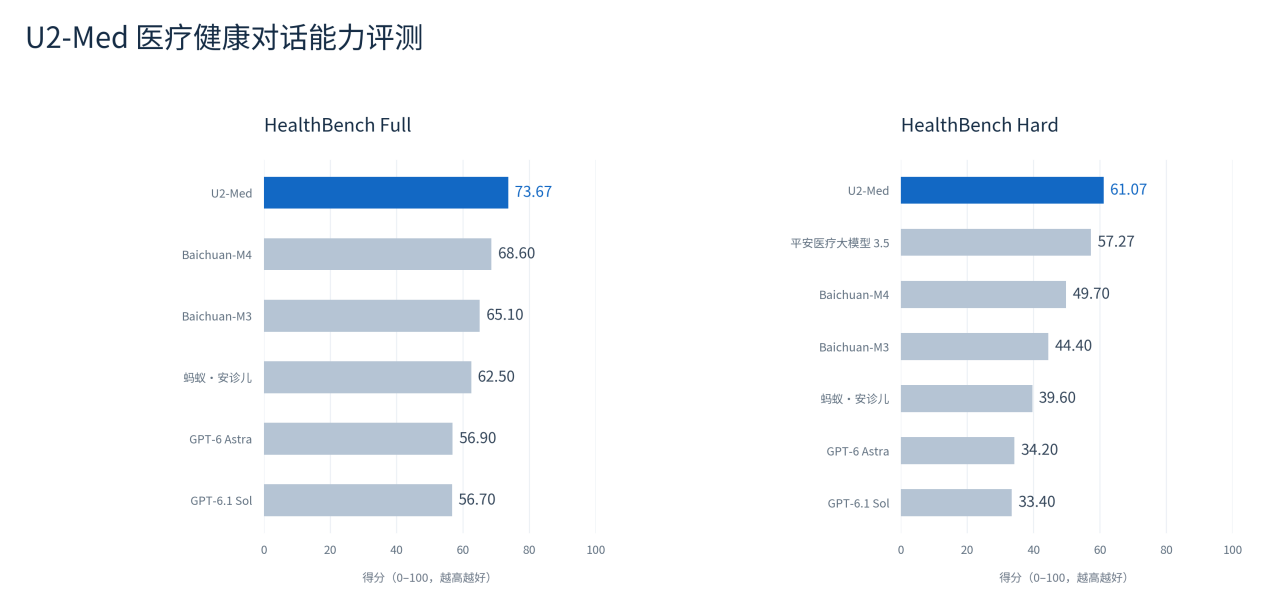
In the latest consolidated results of HealthBench, an authoritative benchmark for healthcare conversations, Unisound's U2-Med delivered standout performance: 73.67 on HealthBench Full and 61.07 on HealthBench Hard, ranking first among the models evaluated in both categories. These results provide an objective interim benchmark for assessing U2-Med's capabilities in longitudinal clinical interactions and medical dialogue.
01 From Answering Individual Questions to Understanding Patients Whose Conditions Evolve
In real-world clinical care, a patient is not a static collection of symptoms. In outpatient consultations, physicians begin with the chief complaint and progressively gather evidence through follow-up questions and examinations. During treatment and follow-up, they must adjust care plans as new test results, symptoms, and patient feedback emerge. Medical AI that can only answer a clearly formulated question cannot adequately support this continuous, dynamic process.
The core principle of a medical world model is: “Current patient state + clinical action → next patient state.” Rather than simply producing longer answers, it integrates incomplete and asynchronous clinical evidence—including medical records, laboratory results, imaging, vital signs, and patient conversations—to estimate the patient's current state. It then simulates possible new information and changes in that state under different actions, such as further questioning, testing, treatment, nursing care, or observation.
With this goal in mind, Unisound has proposed a progressive capability framework: patient-state representation → disease-dynamics modeling → intervention-conditioned simulation → clinical planning support. The model first develops an understanding of the patient's current condition, then learns how diseases evolve and how actions may affect subsequent outcomes, and ultimately provides a basis for comparing alternative clinical pathways. Throughout this process, it explicitly preserves unknowns and uncertainty, adheres to medical constraints, and avoids presenting simulated outcomes as definitive clinical conclusions.
Within the overall technical architecture, the core components play distinct yet closely coordinated roles. The medical world model, U2-Med-World, serves as a simulation environment, providing feedback on actions and enabling the simulation of clinical processes. U2-Med, meanwhile, is the core agent driving sequential clinical interactions. Beyond its strong foundation in medical understanding and reasoning, it selects next-step actions, invokes tools, and updates its clinical strategy in real time based on environmental feedback. Together, the two components advance medical AI from isolated question answering toward continuous clinical decision-making.
02 Building U2-Med-World by Combining Real and Synthetic Clinical Trajectories
For a world model to learn “what happens after an action is taken,” clinical processes must first be represented accurately. U2-Med-World begins with real-world clinical records, aligning fragmented information from medical histories, conversations, laboratory tests, imaging, vital signs, and physician orders by time and source. This information is reconstructed into traceable chains of “state → action → observation → state update.”
A robust clinical trajectory records more than the patient's state. It must also preserve critical elements such as the timeline, observations and examinations, clinical actions, patient responses, state updates, and clinical outcomes. Crucially, the model must distinguish observed facts from physicians' interpretations, and recommended plans from actions actually performed. It must also prevent information that became available later from leaking into earlier decision points. Real clinical trajectories thus provide the foundation for learning from and validating clinical processes that actually occurred.
On this foundation, U2-Med-World can generate candidate synthetic trajectories from the same initial patient state, corresponding to different sequences of follow-up questions, examinations, and management decisions, while remaining constrained by medical rules and case facts. For example, when a patient presents with a vague chief complaint, choosing to first ask about associated symptoms, review past medical history, or screen for warning signs can lead to very different sequences of evidence gathering and subsequent clinical judgments. This multi-path simulation allows the model to compare which actions offer greater clinical value and which critical pieces of evidence might otherwise be missed.
Real trajectories supply the underlying evidence, while synthetic trajectories expand the range of scenarios and possible action branches. The latter are primarily used for training, process simulation, and strategy comparison. They remain simulation outputs requiring independent evaluation and should not be treated as direct evidence of real-world clinical effectiveness.
03 Strengthening Multi-Turn Consultation Skills Through a World-Model Interaction Loop
Proactive history-taking is a core capability of U2-Med in real clinical settings, and U2-Med-World provides the environment in which that capability can be refined. A typical outpatient visit begins with a brief chief complaint and limited known information. At that point, the priority is not to issue an immediate diagnosis. Instead, U2-Med must identify missing evidence, decide what to ask next, revise its assessment as new information arrives, and recognize when to recommend urgent medical attention or further testing.
Using U2-Med-World, Unisound has developed an interactive virtual-patient consultation environment. The world model supplies patient background, state information, and feedback on actions; the consultation environment controls the gradual disclosure of case information; and U2-Med, acting as the interviewing agent, asks follow-up questions, receives answers, updates its evidence base, and plans next steps. The system makes a critical distinction between two types of change: questions and tests change what the model knows, whereas treatment and disease progression can change the patient's underlying physiological state.
Consider a virtual patient whose chief complaints are “fatigue and loss of appetite.” Initially, the model receives only a few clues and must determine the most valuable follow-up questions among symptom duration, associated manifestations, past medical history, and recent medication use. The environment progressively reveals information based on the patient's underlying case profile, allowing the model to adapt its subsequent questions dynamically. For the same initial case, the system can also compare multiple interaction pathways in parallel to assess whether follow-up questioning effectively completes the medical history, identifies risks, and leads to appropriate recommendations for the next step.
Unisound integrates expert clinical demonstrations, process-level evaluation, and post-training around these interaction trajectories. Rubric RL provides fine-grained optimization signals across dimensions such as medical accuracy, information completeness, risk identification, and communication quality. Methods including OPD (Online Preference Distillation) are then used to transfer selected high-quality consultation strategies into U2-Med, helping it internalize the ability to decide what to ask, how to adapt to feedback, and when to offer recommendations or escalate care.
This creates a complete iterative loop: U2-Med-World simulation environment → U2-Med multi-turn interaction → full-trajectory evaluation and selection → post-training optimization → independent evaluation. Rather than optimizing only a single response, this approach emphasizes efficient information gathering, sensitivity to risks, consistency of evidence, and the quality of sequential decisions throughout the consultation process.
04 Leading Both HealthBench Rankings: Evidence of Progress Toward Continuous Clinical Interaction
U2-Med's first-place performance on both HealthBench rankings offers strong evidence of its current medical-dialogue capabilities. At the same time, Unisound's exploration of synthetic clinical trajectories and clinical-process simulation reflects its continued efforts to address two central challenges in medical AI: How can AI provide more accurate responses in complex health conversations? And how can it learn to make sequential decisions as patients' conditions change?
Looking ahead, Unisound will continue to deepen the coordinated development of its medical world model and U2-Med. Through learning from real trajectories, simulated interactions, evaluation feedback, and clinical validation, the company aims to strengthen medical AI's understanding of multi-turn consultations and the full continuum of clinical care.
Our vision is for future medical models not only to respond thoughtfully to every patient question, but also to detect important information that has yet to be uncovered, understand the medical reasoning behind each decision, and—under the review and guidance of qualified professionals—deliver deeper and more meaningful support in real-world healthcare settings.