Unisound Chief Scientist of Large Models Liu Shengping Shares Frontier Research on Medical World Models at the 2026 Physical AI and World Model Conference

The ultimate romance of a medical world model is this: in the many universes we build in silicon, we explore ten thousand possible futures for a single patient, allowing adverse outcomes to unfold first in virtual simulations, so that only the most promising causal pathway, selected through a comprehensive comparison, is brought to that patient's bedside.
On October 19, the Medical and Healthcare World Models subforum of the 2026 Physical AI and World Model Conference was held at the Nanjing International Expo Center. Under the theme “Foreseeing Disease, Simulating Life: World Models Reshape Medical Artificial Intelligence,” experts and scholars from healthcare, research, and the AI industry gathered to discuss emerging directions for world models in disease progression, clinical-process simulation, and intelligent medical decision-making.
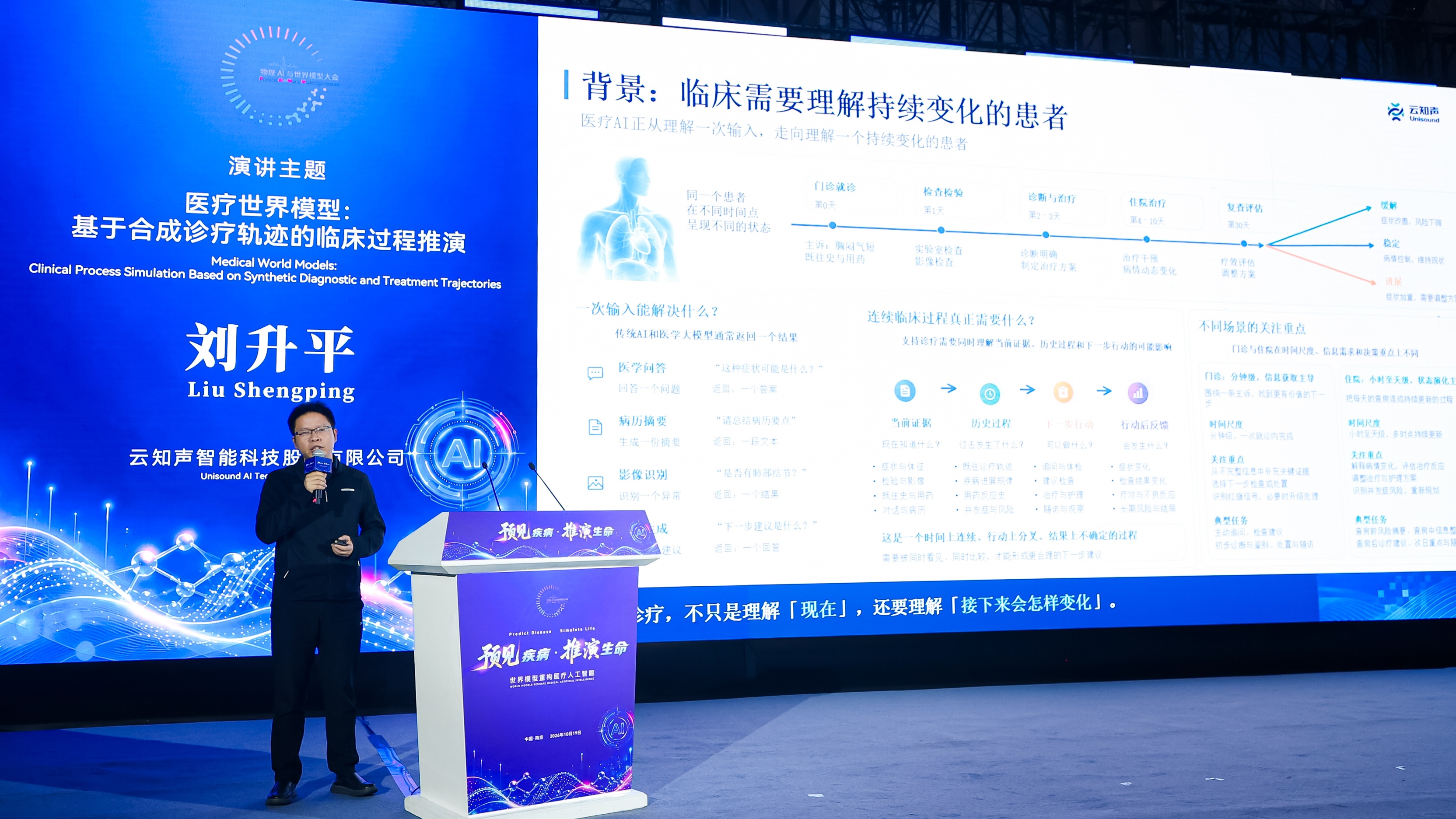
At the event, Liu Shengping, Unisound's Chief Scientist of Large Models, delivered a keynote titled “Medical World Models: Simulating Clinical Processes Through Synthetic Diagnostic and Treatment Trajectories.” He presented Unisound's technical explorations and latest research advances in medical world models.
Real-world clinical care is not a one-off medical question-and-answer exchange. It is a dynamic process shaped by evolving patient conditions, clinical actions, and feedback. Enabling AI not only to understand a patient's current condition but also to continually revise its assessments and explore the next steps as new information emerges has become a key challenge in advancing toward continuous clinical decision-making.
To address this challenge, Unisound developed U2-Med-World, a medical world model that reconstructs real diagnostic and treatment trajectories and generates synthetic clinical scenarios. It creates an interactive virtual-patient consultation environment in which the medical large model U2-Med can learn to ask proactive follow-up questions, dynamically update its assessments, and identify potential risks.
In the latest HealthBench evaluation, Unisound's U2-Med scored 73.67 on HealthBench Full and 61.07 on HealthBench Hard, ranking first among participating models on both benchmarks.
Building on these technical efforts, the keynote explored how medical world models can represent patient states, construct synthetic clinical trajectories, simulate clinical processes, and support clinical agents in learning continuous decision-making through virtual environments.

I. From Understanding Disease to Simulating Life: The Next Frontier for Medical AI
Real-world clinical care has never been a static question-and-answer process.
From initial consultation and testing to diagnosis, treatment, reassessment, and follow-up, a patient's condition is constantly changing. Each new test result and every therapeutic intervention may affect a physician's judgment and the patient's subsequent condition.
Historically, medical AI has largely focused on individual inputs: answering a medical question, generating a medical-record summary, identifying an imaging abnormality, or suggesting a diagnostic or treatment action.
Actual clinical practice, however, unfolds continuously over time, branches with each action, and involves uncertain outcomes. Physicians must understand not only “What is happening to the patient now?” but also “What happened before?”, “What should happen next?”, and “How might different choices change the outcome?”
How can AI move beyond interpreting medical information at a single point in time to understanding a continually changing patient state and exploring possible futures under different clinical actions?
Medical world models offer a new approach to this question.
In Unisound's research, the central relationship underlying a medical world model can be summarized as: Current patient state + Clinical action → Next patient state.
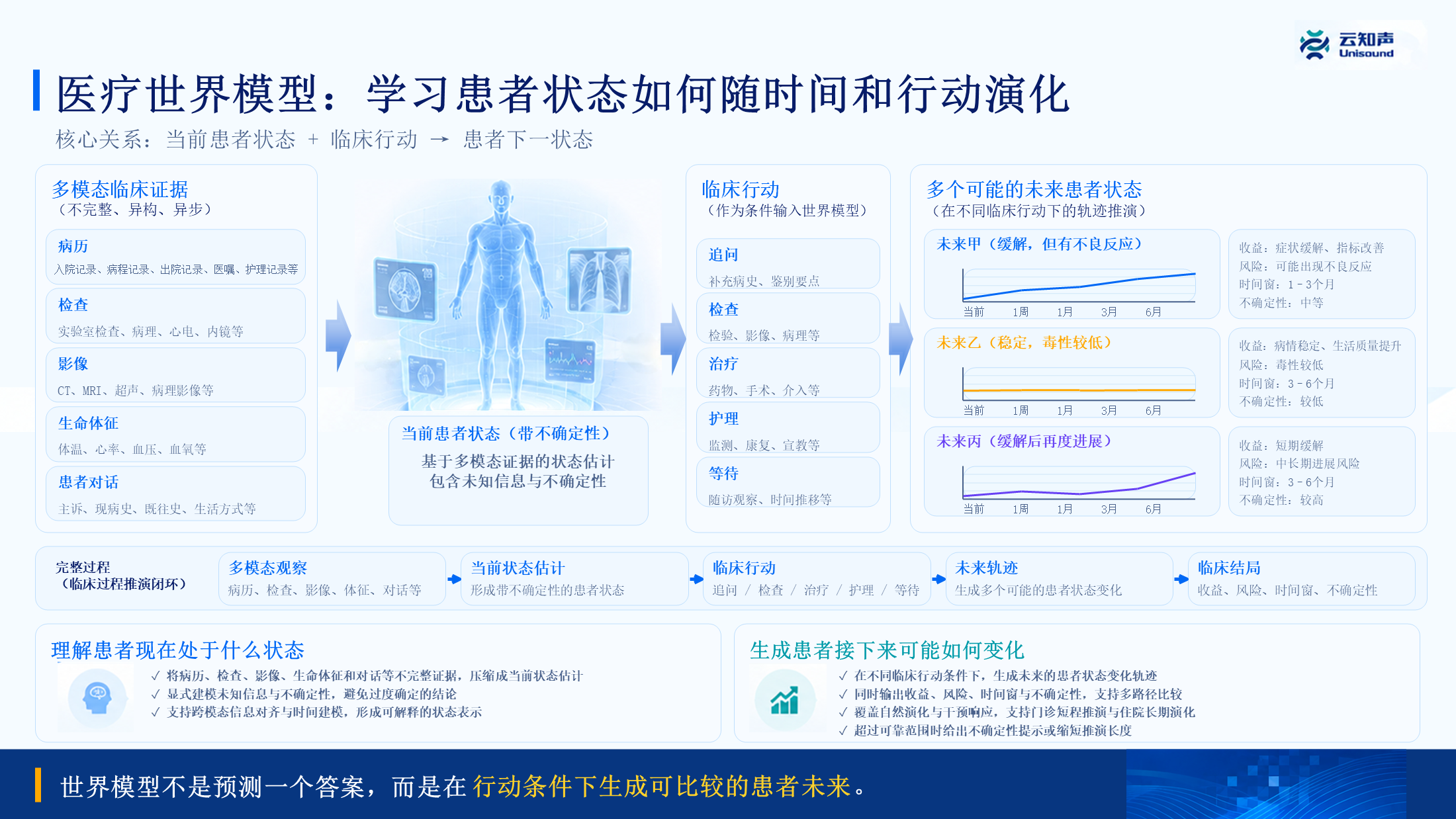
Unlike conventional models that primarily produce a single answer, a medical world model seeks to establish dynamic relationships among patient states, clinical actions, and subsequent changes. It generates multiple possible care pathways under different intervention conditions and compares them across expected benefits, potential risks, time windows, and uncertainty.
To achieve this, medical world models must progressively develop four core capabilities:
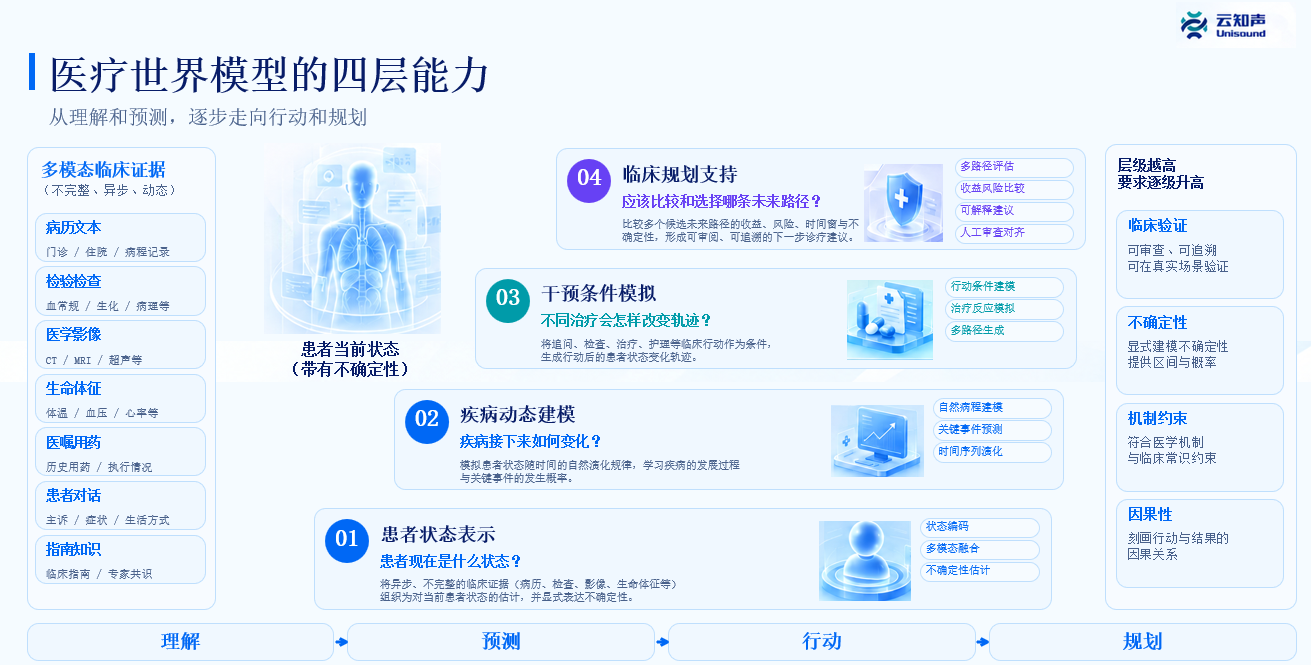
• Patient-state representation: Integrate multimodal clinical evidence—including medical records, laboratory tests, examinations, and imaging—to understand the patient's current state while retaining unknowns and uncertainties.
• Disease-dynamics modeling: Learn how diseases evolve over time and simulate changes in patient state and the likelihood of important clinical events.
• Intervention-conditioned simulation: Use clinical actions, including examinations, treatments, and nursing care, as conditions to simulate the downstream effects of different choices.
• Clinical planning support: Compare the benefits, risks, and uncertainties of candidate care pathways and provide physicians with evidence-based, reviewable recommendations for next steps.
Spanning understanding, prediction, action, and planning, medical world models aim to help AI go beyond answering “What is happening to the patient now?” to exploring “What might happen next?”
II. From Real Trajectories to Countless Possibilities: Making Clinical Processes Learnable and Simulatable
In the real world, each patient experiences only one actual course of care.
Once a physician selects a treatment, the outcomes of alternative options cannot be observed simultaneously in the same patient. Yet clinical decision-making requires judging among precisely these unrealized possibilities.
How can AI learn from clinical processes that have already occurred while exploring the consequences of different choices?
To tackle this challenge, Unisound is exploring synthetic diagnostic and treatment trajectories as a key foundation for learning and simulation in medical world models.

A diagnostic and treatment trajectory is not simply a chronological list of medical records. It is a structured representation of seven elements—patient state, time, observations and examinations, clinical actions, patient responses, state updates, and clinical outcomes—designed to capture the continuous evolution of care.
Within this framework, real and synthetic trajectories serve different purposes:
Real trajectories: Understanding clinical processes that have already occurred.
Real trajectories document the care a patient actually received, preserving the sequence of clinical events, actions taken by physicians, and subsequent patient responses. They provide a foundation for models to learn the relationships among disease progression, clinical actions, and changes in patient state.
Synthetic trajectories: Exploring possible futures that have not yet occurred.
Starting from a real patient state, a model can introduce alternative clinical actions and generate multiple candidate pathways in a constrained virtual environment.
Real-world data record what happened; synthetic trajectories seek to broaden the clinical situations a model can learn from and compare, particularly complex scenarios and long-tail cases that are relatively scarce in observed data.
Virtual simulation, of course, is not equivalent to actual clinical outcomes. The plausibility of synthetic trajectories, the reliability of model predictions, and causal relationships among interventions all require rigorous assessment and independent validation.
The purpose of synthetic diagnostic and treatment trajectories is not to fabricate more medical records. It is to enable AI to learn clinical processes, explore alternative actions, and examine their potential consequences in a virtual environment.
III. From One-Off Encounters to Continuous Decisions: Exploring Real Clinical Settings
Across outpatient and inpatient care, Unisound is investigating the ability of medical world models to simulate clinical processes, with a focus on dynamic patient states and clinical decision-making needs.
Outpatient Care: Identifying Critical Decision Evidence from Limited Information
Outpatient consultations often begin with incomplete information. Symptoms, medical history, and medication use must be clarified progressively, while physicians have limited time to identify key clues and decide what to ask, what to test, and when to escalate care.
For example, in a patient with sudden chest pain, listing possible diagnoses is not enough to support clinical care. The physician must also assess whether a life-threatening condition such as acute coronary syndrome may be present, which information remains unknown, which tests are warranted, and when emergency evaluation should begin immediately.
A clinical agent powered by a medical world model can generate candidate actions based on the patient's current state, including proactive follow-up questions, targeted tests, risk identification, and escalation for further evaluation, while presenting supporting evidence and risk alerts.
As new symptom details and test results become available, the model continuously updates the patient state to help physicians adjust their assessments and next actions.
Inpatient Care: From Individual Ward Rounds to Continuous Management
Unlike minute-by-minute outpatient decisions, inpatient care often spans days or longer. An abnormal measurement today may reflect a treatment adjustment made yesterday, disease progression, or a newly developed complication.
Physicians therefore need more than a daily condition summary: they need an ongoing understanding of the entire clinical course.
To meet this need, medical world models seek to create a dynamic feedback loop throughout inpatient care:
• Before rounds: Integrate previous clinical notes, laboratory and examination results, imaging, and vital signs to identify current issues and potential risks.
• During rounds: Incorporate patient-reported concerns, new physical findings, and physicians' observations to update the patient state.
• After rounds: Use the latest evidence to help recommend repeat examinations, medication reviews, nursing observations, and follow-up monitoring.
• Next-day reassessment: Feed actual actions, treatment responses, and new findings back into the care trajectory to continually refine subsequent plans.
Under this approach, each ward round becomes part of a continuous course of care rather than an isolated record of information.
From proactive information gathering in outpatient settings to sustained management of inpatient clinical courses, medical world models aim to extend clinical decision-making from a single point in time to a continuous, dynamic process.
To support this, Unisound integrates information from medical records, laboratory tests and examinations, medical imaging, physician orders, and other sources onto a unified timeline. By distinguishing clinical facts, actions actually taken, and subsequent feedback, it reconstructs clinical processes into traceable, learnable, and simulatable care trajectories. These form a foundation for learning disease dynamics and enabling clinical agents to make sequential decisions.
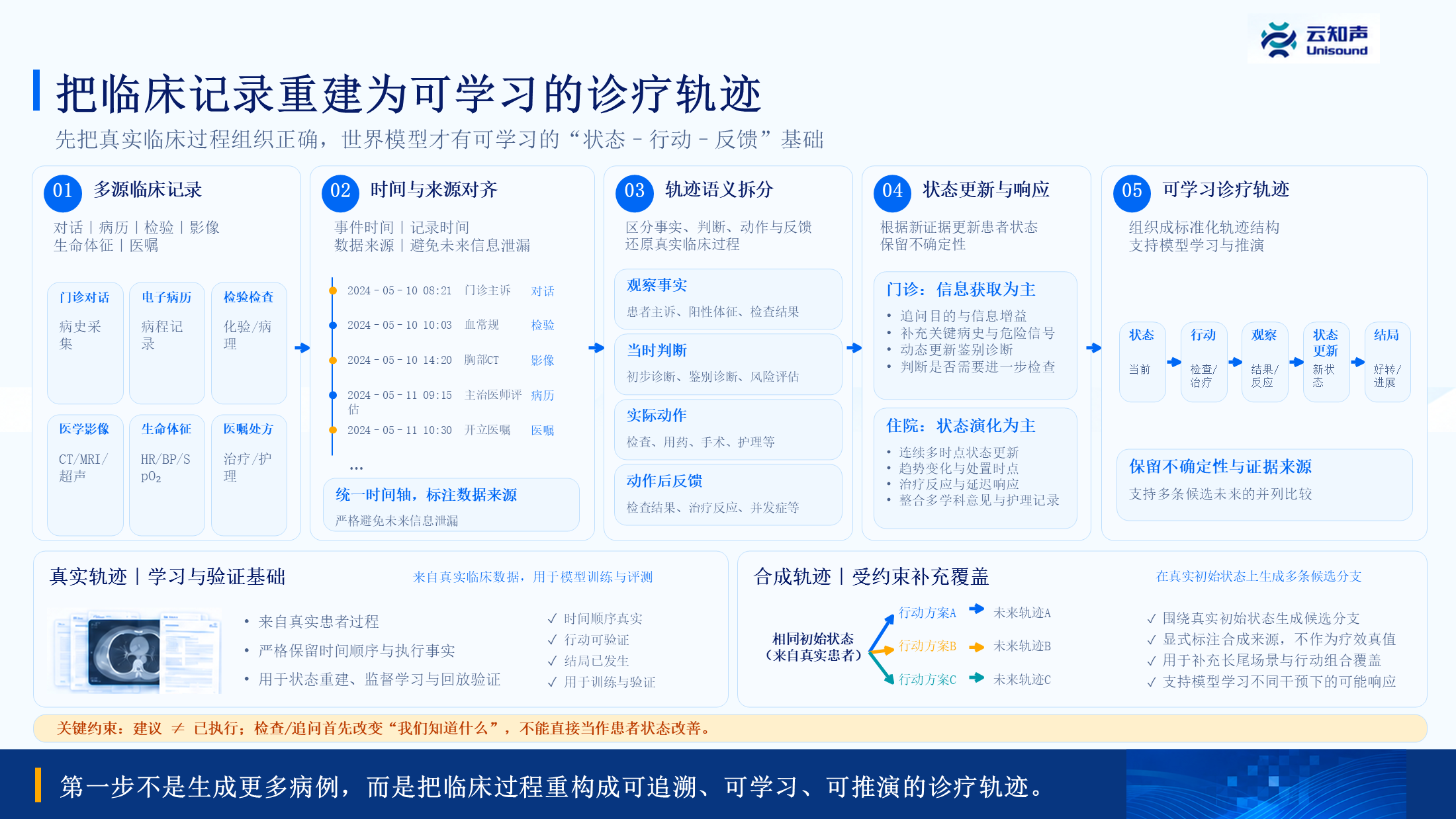
On this foundation, the medical world model conditions its simulations on clinical actions to explore potential downstream changes in patient state. Whereas treatment interventions may change the patient's physiological condition, follow-up questions and diagnostic tests first change the physician's knowledge of that condition. By distinguishing information acquisition from changes in disease state, the model seeks to simulate patient responses to different clinical actions and provide more targeted guidance for subsequent decisions.
IV. From Learning Answers to Learning Decisions: Closing the Loop for Clinical Agents
Understanding the clinical process is only the first step. Unisound is also exploring how clinical agents can learn to select the next action as patient states evolve and continually adjust decisions in response to feedback.
To this end, Unisound is investigating a combination of supervised learning from expert clinical trajectories, multi-step interaction with world models, and reinforcement learning with composable rewards. The goal is to shift agent optimization from “a single response” to “an entire trajectory of clinical actions.”
First, supervised learning draws on real medical records, expert consultation dialogues, annotated diagnostic and treatment trajectories, and clinical guidelines to establish core capabilities in patient-state understanding, identifying information gaps, and action planning.
Next, agents engage in multi-step interactions within the virtual-patient environment created by the world model. An agent proposes an action, such as a follow-up question, examination, or treatment; the world model simulates the resulting observations and state changes; and the agent updates its assessment and selects the next action. Physician review and composable reward mechanisms are then incorporated to continuously refine the clinical strategy, considering not only the accuracy of individual assessments but also information acquisition, clinical risks, the appropriateness of actions, and long-term care objectives.
Ultimately, the ability to simulate clinical processes in a virtual world must be tested in real clinical settings. Unisound therefore proposes a phased pathway of “trajectory reconstruction → offline simulation → clinical feedback.” The first phase validates whether the model can accurately reconstruct actual clinical processes. The second uses offline comparative evaluation to assess information gathering and continuous decision-making. The final phase starts with silent clinical evaluation, in which physicians independently review recommendations, before cautiously exploring clinical decision-support applications based on sufficient validation.
Throughout this process, the model must present not only recommendations but also the reasoning behind them, the purpose of each proposed action, and priorities for subsequent observation, so that physicians can understand, review, and verify its outputs. Physician feedback, actions actually carried out, and patient responses can then be incorporated back into the trajectories to support ongoing model improvement.
Every clinical decision should come with evidence that can be reviewed, alternative pathways that can be compared, and downstream outcomes that can be examined. This is both the technical objective of bringing medical world models into clinical practice and the real-world test of their ultimate value.
Every advance in medicine expands the boundaries of humanity's understanding of life and our ability to confront the unknown. Unisound's ambition is to explore how AI might not only understand what has already happened but also help us glimpse what has yet to unfold.
Looking ahead, Unisound will continue pursuing its strategy of “strengthening foundation models and deepening applications.” Building on large models and agent technologies, the company will further explore the integration of medical world models with real-world clinical settings—advancing AI from medical knowledge comprehension toward simulation of disease progression, and from assisting individual care tasks toward supporting continuous clinical decision-making.
We cannot live a life twice, nor can we turn back time.
But perhaps one day, AI will be able to simulate, again and again in a silicon-based world, the stories that have yet to happen. Disease risks may emerge earlier along virtual trajectories; every care decision may be examined more thoroughly; and physicians confronting uncertainty may gain new ways to glimpse the future.
So that every irreplaceable life may hold more hope in the real world.