Unisound Builds on Two First Prizes at the 2026 National Healthcare Security Medical Imaging AI Competition Awards Ceremony and Explores Practical Adoption with the Second Affiliated Hospital of Guilin Medical University
On November 5, the awards ceremony and results exchange event for the 2026 National Healthcare Security Medical Imaging AI Competition took place in Nanning, Guangxi. Unisound attended with two first prizes and joined peers from healthcare, healthcare security and industry to share innovations in medical imaging AI through project showcases, industry matchmaking roadshows and cooperation signing activities, exploring paths toward practical application and the adoption of research outcomes.
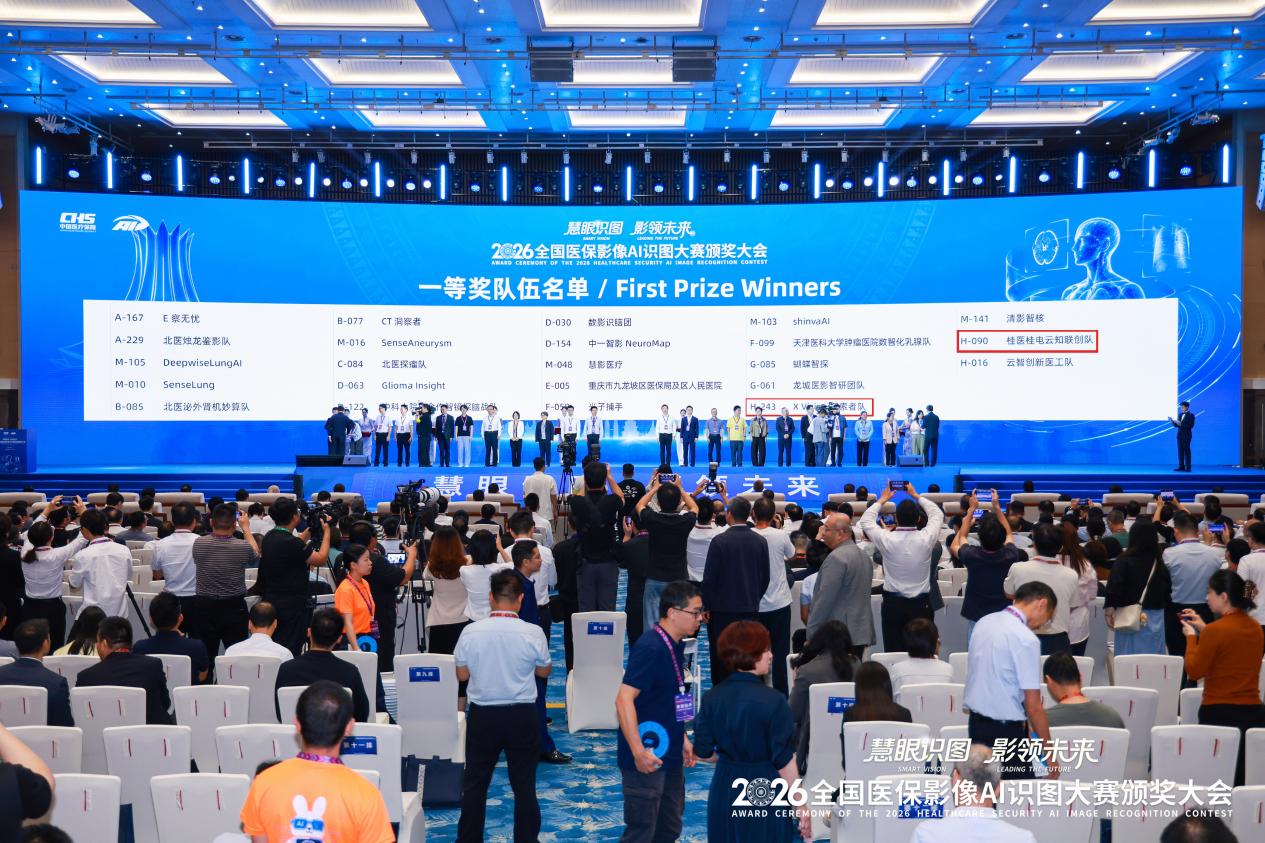
Following multiple rounds in the preliminary and final stages, the Guiyi–Guidian–Unisound Joint Innovation Team and the X Vision Explorers Team, both jointly formed with Unisound, delivered strong performances in the “Intelligent Detection of Multiple Diseases Based on Chest X-rays” track, winning first prize in the Proprietary Model and Self-Built Model categories, respectively.
Two First Prizes Demonstrate Medical Imaging AI Capabilities
Jointly organized by the National Healthcare Security Administration and the People’s Government of the Guangxi Zhuang Autonomous Region, the 2026 National Healthcare Security Medical Imaging AI Competition adopted the theme “Intelligent Image Recognition, Imaging the Future.” The competition focused on practical needs in healthcare and healthcare security to advance innovation and applications in medical imaging AI.
The competition attracted 1,332 teams from universities, healthcare institutions, technology companies and research institutes in China and abroad, with 66 teams advancing to the in-person finals. The two teams jointly formed with Unisound stood out in Track 8, “Intelligent Detection of Multiple Diseases Based on Chest X-rays”: the Guiyi–Guidian–Unisound Joint Innovation Team won first prize in the Proprietary Model category, while the X Vision Explorers Team won first prize in the Self-Built Model category.
The two awards reflect the joint teams’ collaborative work to address practical needs in healthcare and healthcare security. For chest X-ray analysis, the teams developed a multitask image recognition solution integrating image verification, lesion detection and quantitative analysis to support clinical interpretation and the review of medical images for healthcare security purposes.
For clinical interpretation, the solution detects 17 types of lesions on chest X-rays and supports tasks such as pleural effusion grading and estimation of the maximum diameter of masses, providing physicians with lesion localization and quantitative reference information. For healthcare security image verification, it identifies non-human images and spliced images and retrieves duplicate images to help screen for anomalous images or images suspected of sharing the same source, providing leads for further review by assessment personnel.
Stronger Partnerships Connect Competition Results with Practical Needs
Bringing technical achievements from competition into practice requires sustained collaboration among healthcare institutions, technology companies and industry partners. At the event, Unisound signed an agreement to join the U+ Healthcare Alliance as a member. Through this platform, Unisound will expand its network of partners, deepen exchanges on healthcare AI technologies and accelerate deployment in practical settings.
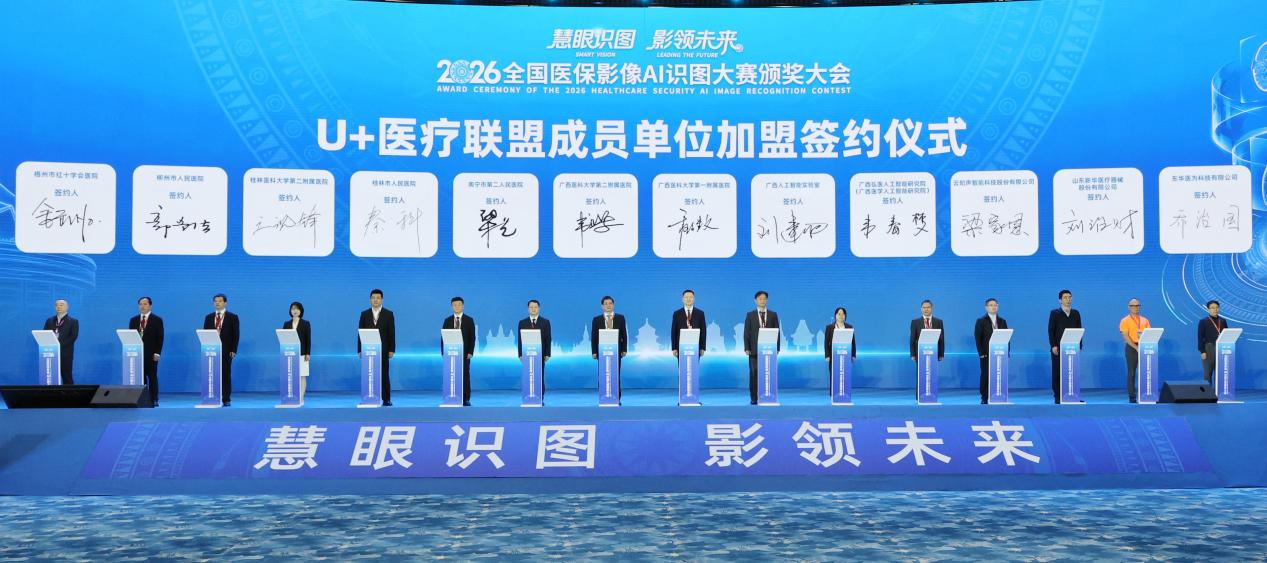
Unisound also signed a letter of intent with the Second Affiliated Hospital of Guilin Medical University to explore the practical adoption of the competition outcomes, laying the groundwork for closer alignment between the award-winning results and the hospital’s needs. The collaboration will explore practical applications of medical imaging AI, combining the hospital’s clinical requirements with Unisound’s technical experience in medical image recognition, large model research and development, and engineering implementation to connect innovations developed during the competition with healthcare service needs.
The two parties will continue discussions around specific operational needs, explore pathways for validating and applying the results in real-world settings, and refine the technical solution based on user feedback. These efforts aim to help medical imaging AI better support clinical work and advance the use of intelligent technologies in healthcare services.
U2-Med Provides the Foundation for Healthcare and Healthcare Security Applications
From medical image recognition to healthcare security operations, Unisound continues to develop specialized large models and explore practical applications. Guided by needs across healthcare, medical insurance including commercial health insurance, and pharmaceuticals, the company is working to integrate AI more deeply into industry workflows.
In healthcare security, Unisound won the contract for China’s first provincial-level domain-specific large model project in this field, developing a dedicated model for Jiangsu Province. Built on U2-Med, Unisound’s independently developed large model spanning healthcare, medical insurance and pharmaceuticals, the model is trained and optimized using healthcare security policies, operational knowledge and private-domain data, exploring intelligent support for scenarios such as healthcare security administration and fund oversight.
Specialized evaluations have further assessed the capabilities of Unisound’s medical and imaging models. In MedBench 5.0, a Chinese-language medical large model benchmark, U2-Med ranked first on the agent evaluation leaderboard with a score of 99.2, while the medical imaging model U2-RadiMed topped the all-modal large model leaderboard.
On HealthBench, the healthcare benchmark introduced by OpenAI, U2-Med scored 73.67 on the Full test set and 61.07 on the Hard test set, ranking first among the models evaluated in this round on both sets. These results demonstrate the model’s capabilities in medical dialogue and understanding specialized knowledge.
04 Integrating a Medical World Model to Explore Broader Healthcare AI Applications
From image recognition to decision support, healthcare AI needs to identify abnormalities in individual images while also incorporating medical records, test results and other information to understand a patient’s overall condition and care process.
To advance this work, Unisound developed the medical world model U2-Med-World. By reconstructing real diagnostic and treatment trajectories and generating simulated clinical scenarios, it creates an interactive environment for consultations with virtual patients. This enables the medical large model U2-Med to learn, through simulated interactions, to ask follow-up questions proactively, update its assessments dynamically and identify potential risks, exploring ways to improve AI’s understanding of care as a continuous process.
Unisound will continue to explore how medical image recognition, large models spanning healthcare, medical insurance and pharmaceuticals, medical world models, and agent technologies can work together. Guided by practical needs across healthcare, medical insurance including commercial health insurance, and pharmaceuticals, the company will investigate the joint analysis of images, medical records, test results and other information sources to provide richer reference information for clinical decision support, healthcare security review and fund oversight.
Building on its two first prizes and partnerships to explore practical adoption, Unisound will continue to validate and apply healthcare AI technologies in real-world settings, helping extend high-quality imaging assistance to more primary care settings. The company will also explore AI’s role in healthcare security image verification and anomaly detection to support the secure operation and more precise oversight of healthcare security funds.