Medical World Models Help AI Understand the Evolving Clinical Care Process | Unisound Chief Scientist for Large Models Liu Shengping Shares Insights at CHIP 2026
When AI can explore a code repository to help developers identify problems, modify code and verify the results, what can this way of working teach us about medical large language models?
The 12th China Health Information Processing Conference (CHIP 2026) took place in Dalian from October 30 to November 1. Under the theme “Healthcare: Large Models and Agents,” the conference brought together researchers and clinical experts in medical artificial intelligence to discuss advances in large models and agents, as well as their practical applications.
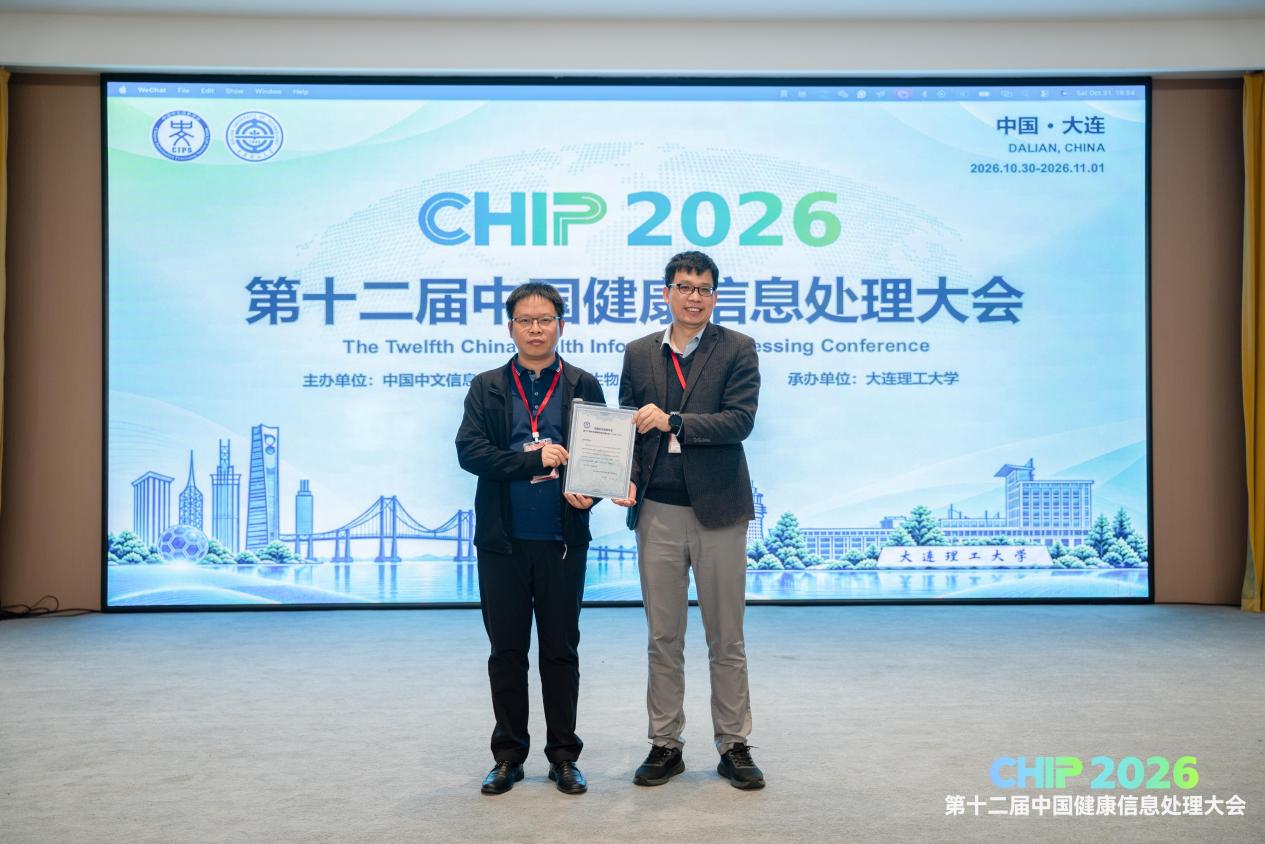
At the conference, Liu Shengping, Chief Scientist for Large Models at Unisound, delivered a presentation titled “Unisound U2-Med: Data, Training and Applications to Advance Innovation in Healthcare, Medical Insurance and Pharmaceuticals.” He shared his perspectives on training methods and future directions for medical large language models.
Starting with coding models, Liu drew parallels between fixing software problems and clinical diagnosis and treatment. He outlined three key perspectives on real-world medical records, medical world models and training for sequential decision-making.
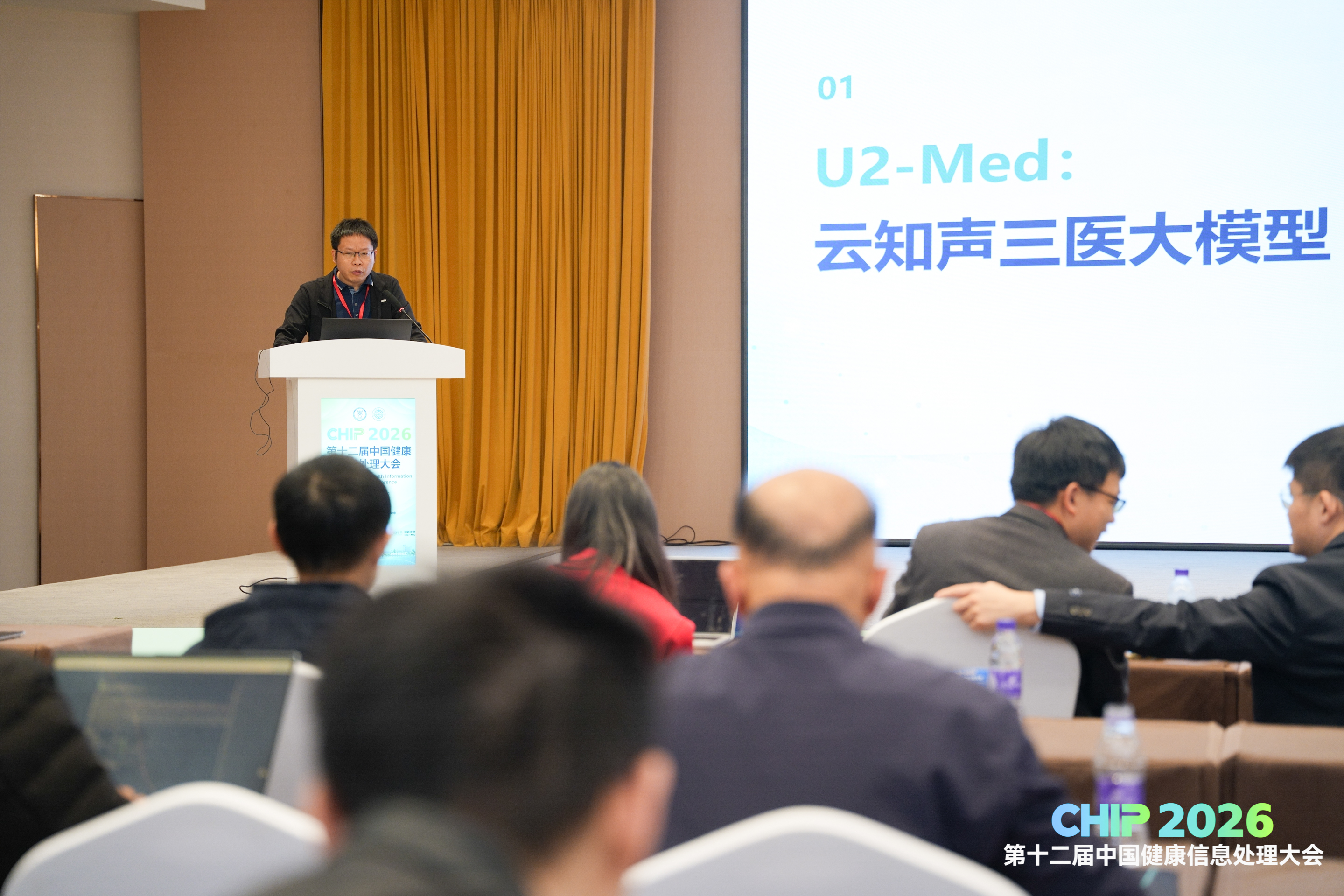
Key Insight 1 Medical and Coding Models Are Closely Alike in Diagnosing and Repairing Complex Systems
In software development, solving a problem often begins with a developer submitting an issue.
Given a problem description, a coding model needs to use the context of the code repository to examine relevant files, review runtime logs, identify possible causes and propose code changes. After making those changes, it must also run tests to verify whether the problem has been resolved and whether other functionality has been affected.
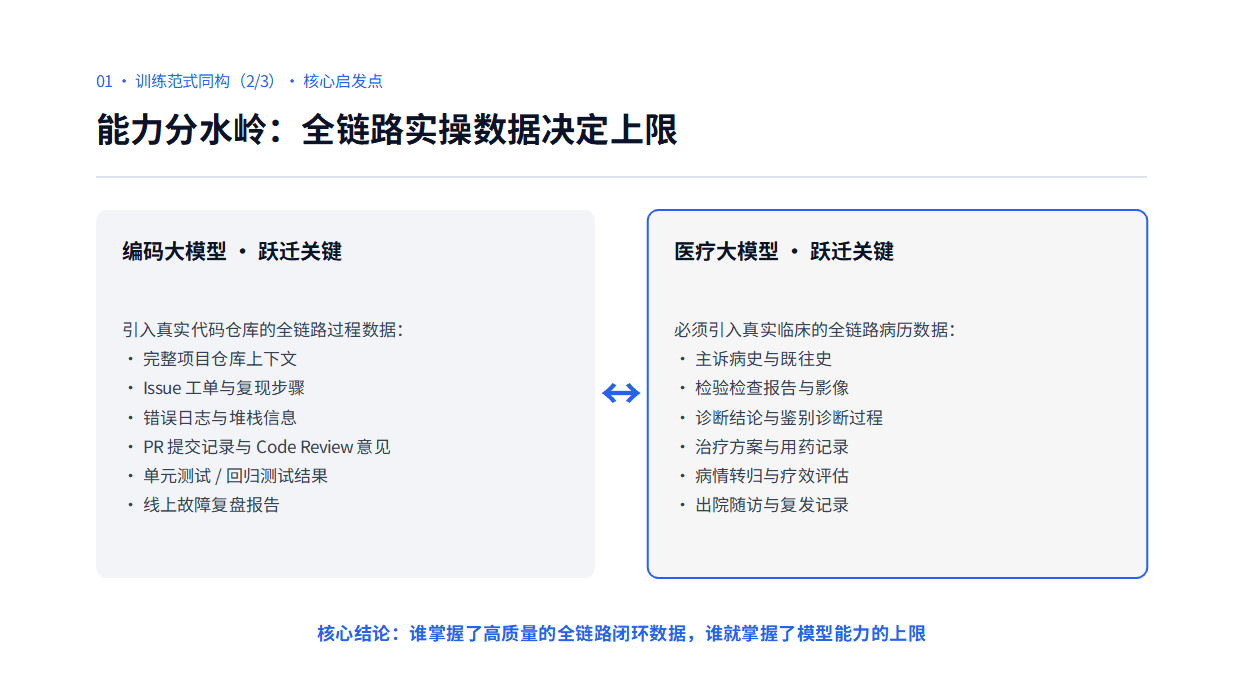
This process resembles the clinical care a patient receives from admission to discharge.
When a patient is admitted, the physician first reviews the chief complaint, symptoms and medical history. Laboratory tests and other examinations then provide evidence for differential diagnosis, helping the physician gradually establish a clearer understanding of the condition. After developing and implementing a treatment plan, the physician must monitor the patient’s response and adjust subsequent care based on follow-up findings. For some patients, follow-up and long-term health management continue after discharge.
From identifying a problem to gathering information, analyzing causes, taking action and verifying results, both coding and clinical care require a series of interconnected judgments within a complex context.
This analogy offers a useful perspective on the development of medical large language models. Clinical problems rarely exist in isolation: a test result, a detail in the medical history or a medication adjustment may all influence subsequent judgments. Medical models need to understand the links between different stages of care within the patient’s clinical context and update their recommendations as new evidence emerges.
At the same time, because medical decisions involve patient safety and individual differences, physicians must review model recommendations in light of clinical evidence.
Key Insight 2 Medical Models Cannot Truly Be Applied in Clinical Care Without Training on Vast Amounts of Medical Record Data
Medical textbooks, guidelines and research literature provide an essential foundation for medical models to acquire medical knowledge. Real-world clinical care, however, is often more complex than standardized medical question answering: the same symptom may point to different diseases, and the same test result must be interpreted alongside the medical history, medications and other evidence.
Coding models can learn to address real engineering problems from issue records, code changes and test results in code repositories. For medical models, real-world medical records that document patients’ conditions, clinical actions and subsequent feedback are similarly important for learning the clinical care process.
The value of a medical record extends beyond the final diagnosis. The continuous record of a patient’s symptoms, examinations, the physician’s judgments, treatment, changes in the patient’s condition and subsequent follow-up shows how clinical decisions unfold as the evidence evolves.
Organizing medical records, laboratory and examination results, imaging, vital signs and medical orders chronologically, while distinguishing observed facts, physicians’ assessments, actions taken and subsequent feedback, helps progressively reconstruct the patient’s care trajectory.
What information did the physician have at each point in time? What actions were taken? What happened afterward? These clues help models understand the relationship between clinical judgments and changes in the patient’s condition, allowing them to learn more about real-world clinical care.
Key Insight 3 Joint Training of Medical Language Models and Medical World Models Is the Way Forward
Real-world medical records provide a foundation for medical models to learn from clinical experience. But how can models practice in different situations and continually improve based on feedback? Liu proposed exploring joint training of medical language models and medical world models as a way to address this question.
Following this approach, Unisound has developed the medical world model U2-Med-World and is exploring its joint training with the medical large language model U2-Med, enabling the models to deepen their understanding of continuously evolving clinical processes while learning medical knowledge.
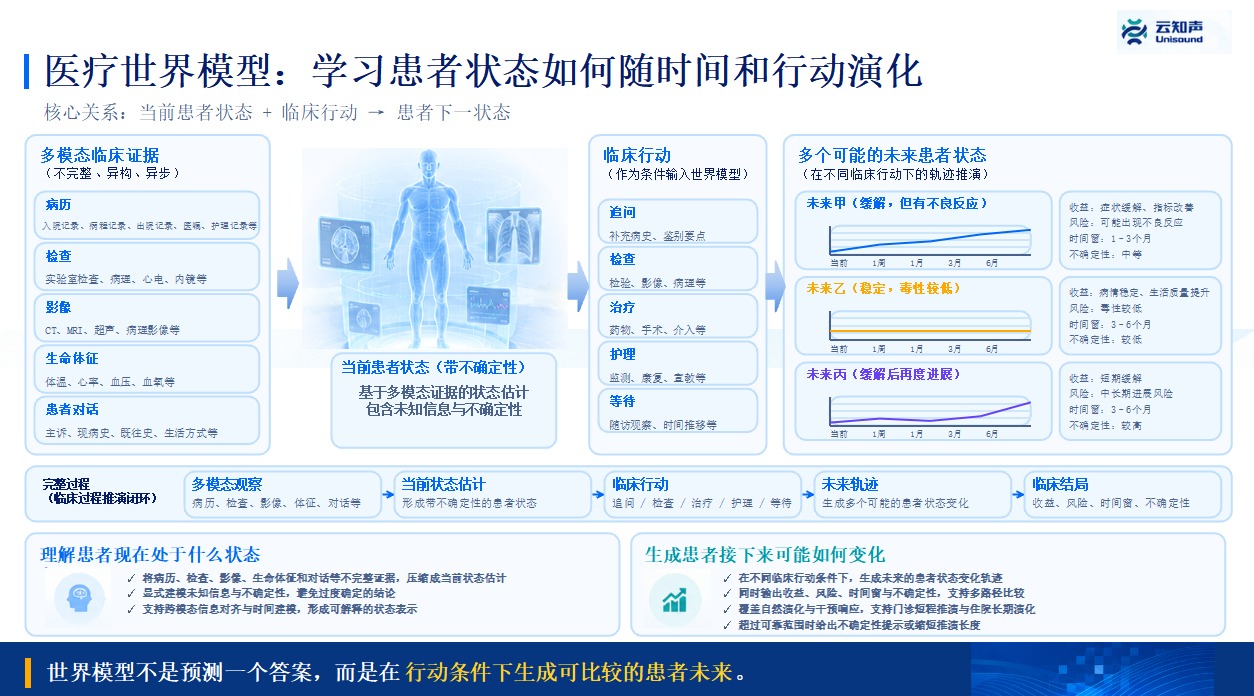
The two types of models have distinct training focuses. U2-Med handles medical knowledge comprehension, medical record interpretation and clinical reasoning. U2-Med-World focuses on how a patient’s state changes over time and in response to clinical actions, seeking to simulate possible subsequent scenarios under different conditions.
Real-world care trajectories document what has already happened and form the basis for model learning and validation. Building on these records, U2-Med-World uses synthetic trajectories to add simulated scenarios, providing U2-Med with an interactive virtual training environment.
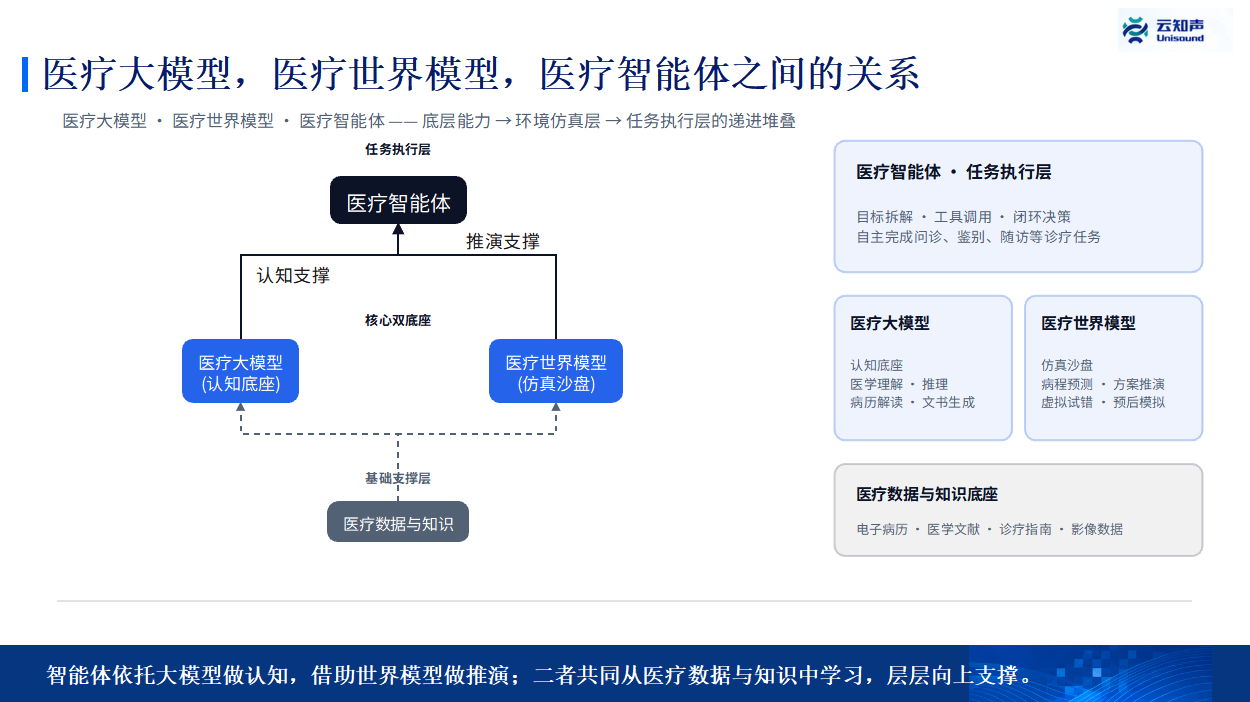
In a consultation, for example, U2-Med proposes follow-up questions or examinations based on the available information. U2-Med-World simulates possible patient responses or examination findings, and U2-Med then updates its assessment and chooses the next action. Through multiple rounds of interaction, the model can practice information gathering and clinical reasoning in evolving situations.
Medical dialogue capabilities are an important foundation for this process. In the latest compiled results for HealthBench, the medical dialogue evaluation introduced by OpenAI, U2-Med scored 73.67 on HealthBench Full and 61.07 on HealthBench Hard. It ranked first among the models included in this evaluation on both benchmarks, ahead of Baichuan-M4, Baichuan-M3, Ant Anzhen’er, GPT-6 Astra, GPT-6.1 Sol and other participating models.
Building on dialogue capabilities, medical world models introduce changes in patient state and feedback from actions. This provides a training environment in which models can learn to gather information and adjust their judgments through ongoing interaction, extending medical AI beyond individual answers toward an understanding of the complete clinical care process.
Coordinating Multiple Models to Support Healthcare Applications
To address diverse needs across healthcare, medical insurance and pharmaceuticals, Unisound has developed a portfolio of specialized models covering text, documents, speech and imaging. These include U2-Med for healthcare, medical insurance and pharmaceuticals; U2-OCR-Med for medical information extraction; and U2-RadiMed for medical imaging.
Through model orchestration and knowledge augmentation, these models can work together to support applications such as medical record generation and quality control, medical insurance review, medical image analysis and patient services. This helps integrate AI capabilities into healthcare workflows and provides professionals with intelligent support that can be reviewed and verified.
These model services are now available to individuals, developers and organizations. Visit the Unisound MaaS platform to learn more and try them:
Unisound MaaS Platform: https://maas.unisound.com/