Unisound Ranks 13th Globally and 7th in China on Arena Labs Leaderboard With Validated End to End Coding Capabilities
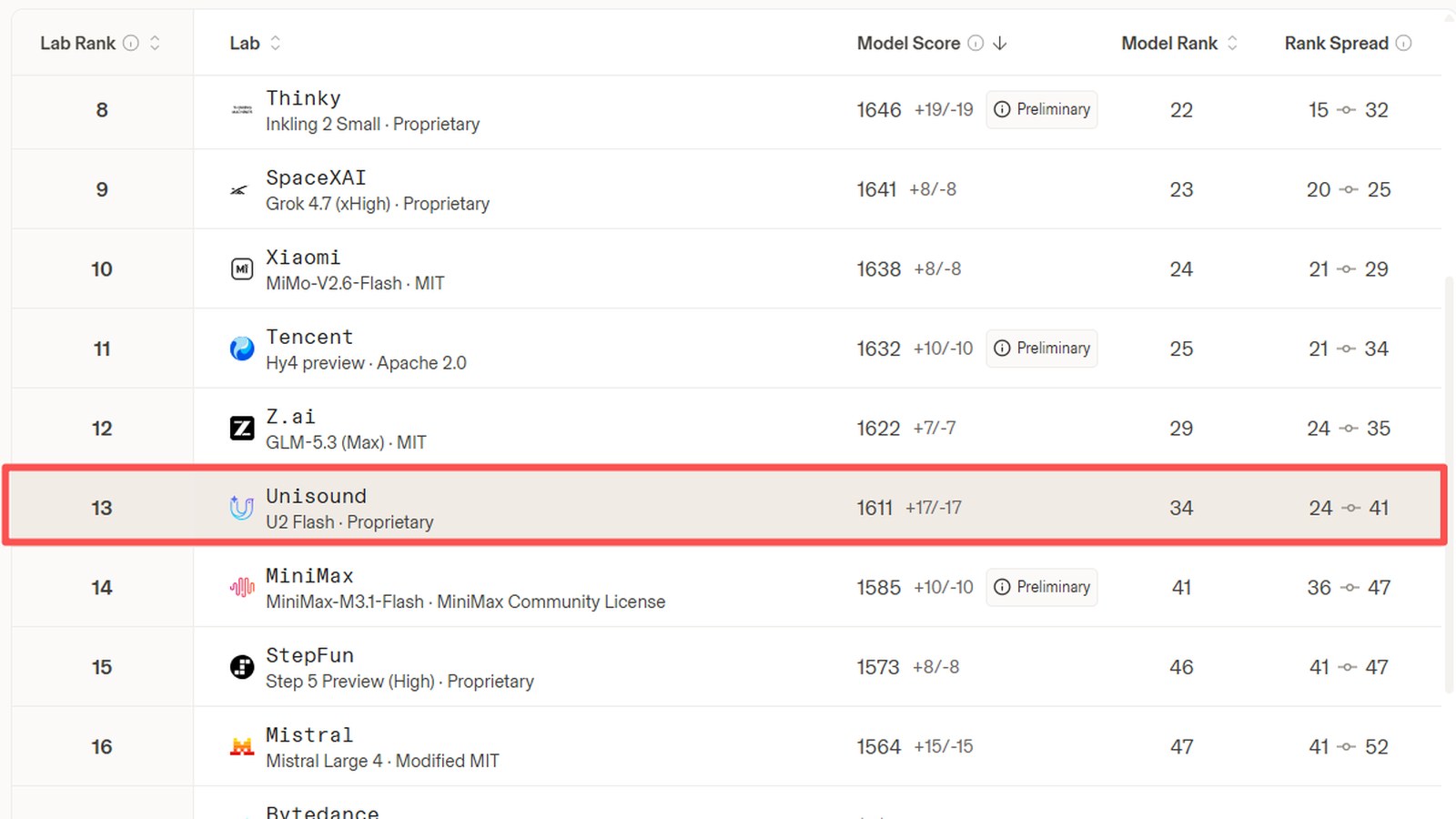
Arena, the global AI model evaluation platform, recently updated the Overall leaderboard for Code Arena | WebDev. Widely recognized in the industry as a highly credible platform for comprehensive large-model evaluation, Arena is regarded alongside the Artificial Analysis (AA) Intelligence Index as one of the world’s two leading authoritative large-model benchmarks. Its evaluation framework centers on anonymous pairwise comparisons and human preference voting, making the results a valuable reference. This mechanism is difficult to game through targeted optimization and can accurately reflect models’ practical capabilities.
U2-Flash, Unisound’s self-developed next-generation high-performance model, scored 1,611 points, ranking 34th globally among the 157 models on the Models leaderboard.
On the same leaderboard, U2-Flash outperformed models including Zhipu’s GLM-5.3-Flash (1,609), Anthropic’s Claude Haiku 5.5 (High) (1,594), MiniMax-M3.1-Flash (1,585), OpenAI’s GPT-6 Luna (Max) (1,577), StepFun’s Step 5 Preview (High) (1,573) and ByteDance’s Seed2.1 Pro Preview (1,519).
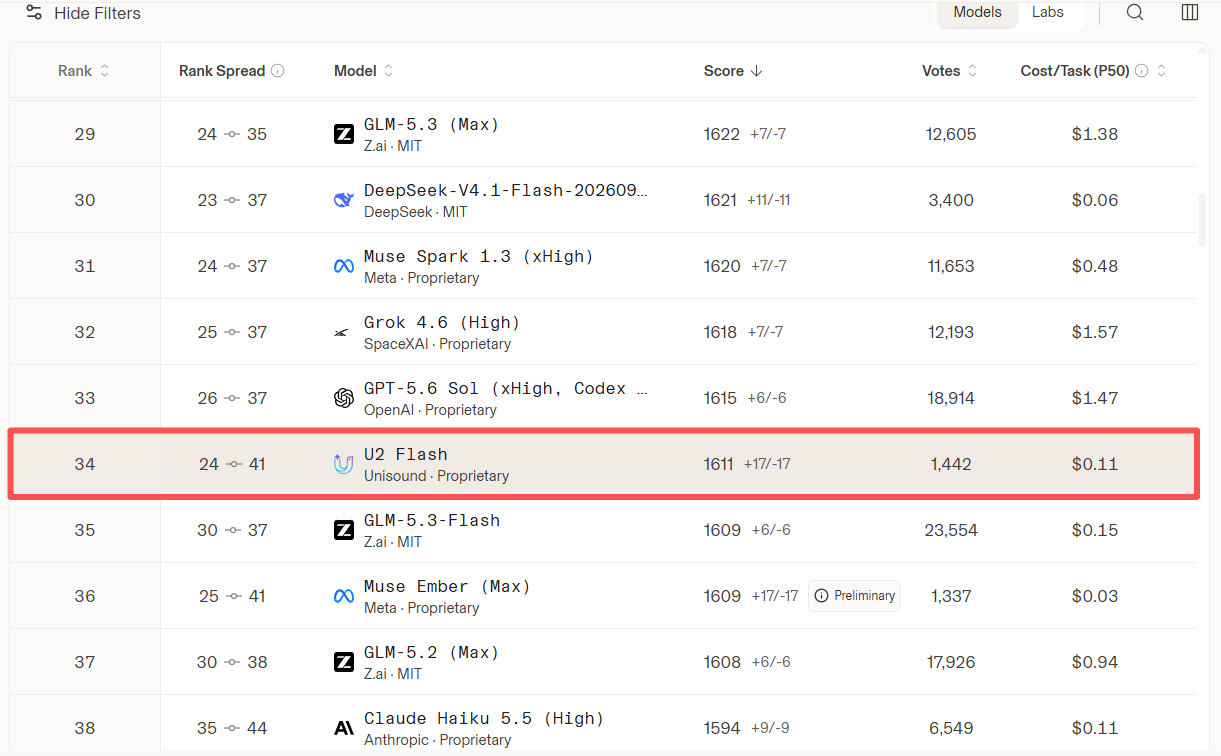
Code Arena | WebDev Models leaderboard
On the Labs leaderboard, which ranks organizations by their highest-scoring model, U2-Flash placed Unisound 13th globally and 7th in China, ahead of MiniMax (14th globally), StepFun (15th), Mistral AI (16th), ByteDance (17th) and NVIDIA (20th).
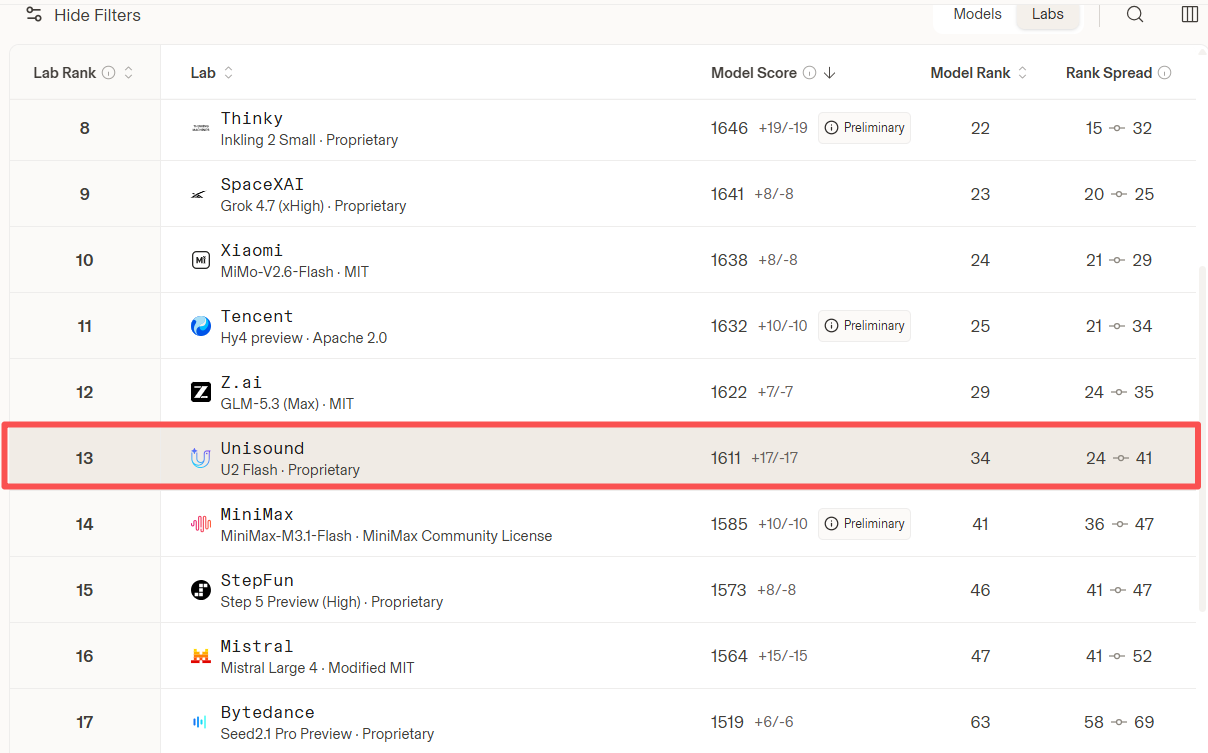
Code Arena | WebDev Labs leaderboard
The result demonstrates U2-Flash’s combined capabilities in task understanding, multi-step reasoning, code generation and tool use for front-end development, providing further validation of its practical coding capabilities for real-world development needs.
View the official Arena WebDev leaderboard:
https://arena.ai/leaderboard/code/webdev
01 Testing Practical AI Coding Capabilities From Understanding Requirements to Delivering Results
Assessing an AI model’s coding capabilities requires looking beyond whether it can write code. It also means examining whether it can complete the entire process, from understanding requirements to delivering results, in pursuit of a development goal.
In real-world development tasks, users often specify a goal rather than a detailed sequence of steps. The AI must understand their intent, break down the task, reason through multiple steps, call tools when needed and adjust its approach based on execution results, ultimately delivering an outcome that meets the requirements. This process tests the model’s combined capabilities in understanding, planning and execution.
In web development, for example, an AI must do more than write code. It needs to translate a user’s ideas into pages and features, coordinate design, interaction and implementation, and ultimately deliver a functioning website.
Arena’s Code Arena | WebDev leaderboard provides a concrete setting for evaluating comprehensive AI coding capabilities. Built around practical programming tasks, it covers agentic coding workflows that require multi-step reasoning and tool use, assessing models across requirements understanding, task planning and code implementation.
U2-Flash’s performance on the leaderboard demonstrates its capabilities in task understanding, multi-step reasoning, code generation and execution. By taking natural-language requirements and producing completed web pages, U2-Flash showed its ability to translate user intent into tangible results in this evaluation setting.
To illustrate U2-Flash’s coding capabilities more directly, we selected six types of examples: web games, 3D scenes, brand websites, lifestyle service websites, personal finance dashboards and 3D building-block editors. From constructing a racing game’s visuals and displaying game states to visualizing financial data and building 3D scenes and editing interfaces, U2-Flash translated different natural-language requirements into web-based results, demonstrating its capabilities in page development, data presentation and 3D interface construction.
02 Advancing Task Execution From Industrial Grade Coding to Agentic Programming
U2-Flash is Unisound’s next-generation high-performance model built for real-world tasks, with capabilities spanning reasoning, office productivity, coding and AI agents. Systematic post-training and recursive self-improvement (RSI) are key technical approaches used to continually improve its reasoning, planning and execution in complex tasks.
Previously, in a comprehensive practical coding evaluation based on challenging open-source benchmarks for industrial-grade tasks, including ArchXBench, BigCodeBench-Hard, BenchCAD, Spider 2.0 and Harbor-Index, U2-Flash ranked second among the evaluated models by overall average score. It also took first place in four categories: builds, compilation and cross-platform migration; digital logic and chip-level RTL; 2D vector rendering through code; and long-horizon tool-use decision-making.
From industrial-grade practical coding to agentic programming tasks, U2-Flash has been tested across different development settings. Its latest Arena WebDev result further demonstrates its ability to translate natural-language requirements into completed web pages.
Beyond coding, U2-Flash also supports reasoning, office productivity and AI agents. Guided by practical needs in healthcare, medical insurance, rail transit and smart cockpits, it is exploring large-model applications in a broader range of settings.
Follow the link or scan the QR code below to visit Unisound’s MaaS platform and explore its full-stack model capabilities: