From Exploring Requirements to Sustained Development: The Technical Innovations Behind U2-Flash
Coding agents can fix bugs and write code based on specified requirements. But what happens when they must discover the requirements themselves and repeatedly revise their implementations? Can they keep a task moving forward over an extended period?
This is a key capability that Unisound is focusing on as it develops U2-Flash for complex software engineering, long-horizon tasks, and multi-step agent scenarios.
To address these challenges, Unisound and a research team led by Professor Jinsong Su of Xiamen University jointly proposed ProgramGym, exploring long-horizon program replication from two perspectives: training environments and development workflows. The related technologies have been applied to the development of U2-Flash, supporting its capabilities in complex tasks and coding agents.
01 Innovative Training Environments: Enabling AI to Discover Requirements Through Real Programs
Given only an executable reference program and its accompanying documentation, how can AI build a program from scratch that behaves consistently with the reference—without accessing its source code?
It must run the reference program, observe its inputs and outputs, gradually uncover the requirements, and then design and implement a solution. Training these abilities requires a sufficiently large collection of interactive, verifiable tasks. Yet real-world repositories vary in dependencies, build processes, and functionality, making it difficult to scale environment setup and test preparation.
Program-Env integrates reference-program builds, runtime sandboxes, and black-box test generation into an automated pipeline, continuously refining the process based on build diagnostics and test-quality feedback.
Its innovation lies in incorporating both whether a program can run and how replication performance can be verified into environment construction. This turns real code repositories into training tasks that agents can explore, implement, and have evaluated.
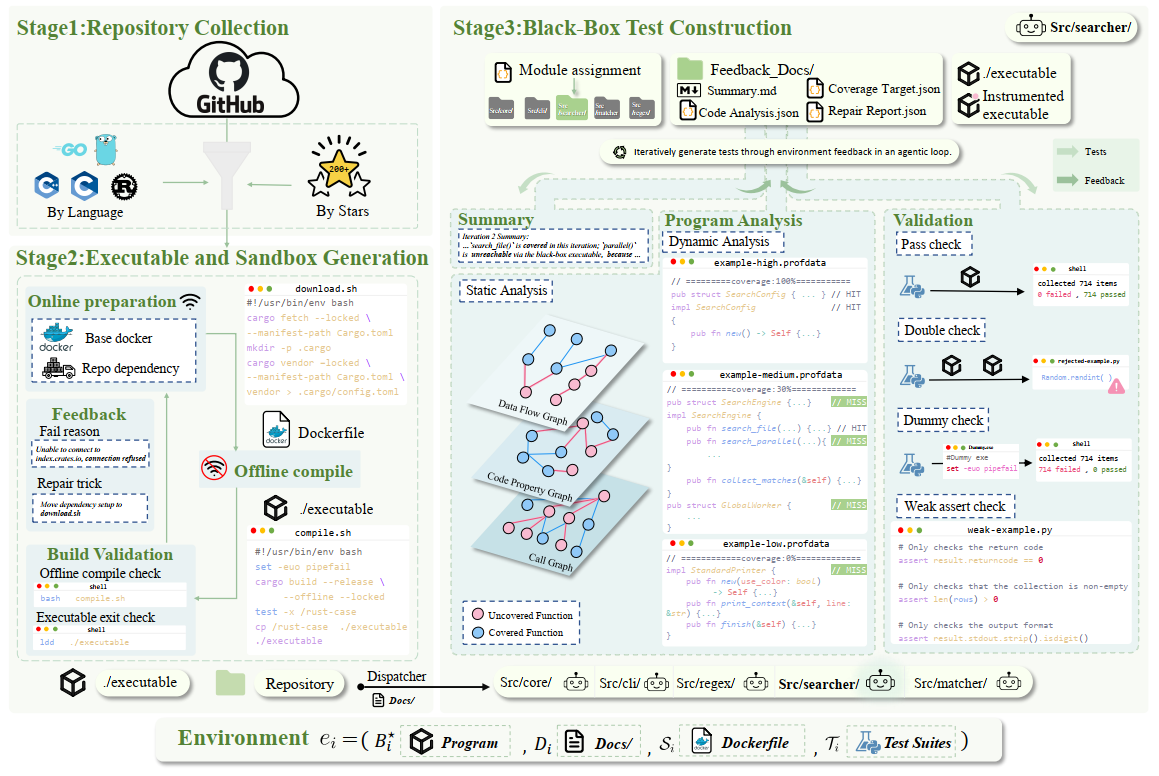
To date, ProgramGym has built 1,648 training environments spanning C, C++, Go, and Rust, providing reusable task resources for collecting training trajectories and subsequently training models.
02 Innovative Development Workflows: Keeping Long-Horizon Tasks Documented and Recoverable
The longer a task runs, the more likely an agent is to forget requirements discovered early on. Repeated rounds of modification may also disrupt implementations that were already completed.
Program-Agent separates analysis, implementation, and review into independent sessions, using persistent records to hand off behavioral evidence, development progress, and requested changes.
In the analysis stage, the agent explores the reference program. In the implementation stage, it writes code based on the recorded findings. In the review stage, it compares program behavior and translates discrepancies into tasks for the next iteration. In this way, discovered requirements carry forward into subsequent development instead of remaining confined to a single conversation.
Version control also supports recovery from failures. Each iteration undergoes an independent compilation check, and successful versions are saved as checkpoints. If a later execution fails, the workflow can revert to a previously verified version.
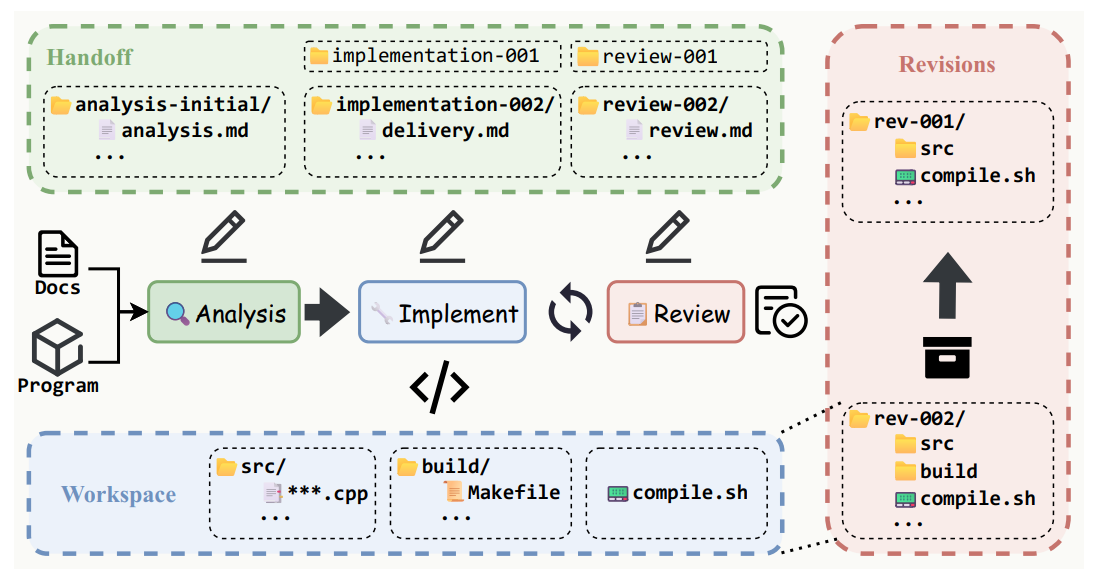
This design addresses practical challenges in long-horizon development: preserving requirements, organizing iterations, and continuing work after failures. It also aligns closely with the development needs of U2-Flash for multi-step engineering tasks.
03 From Public Experiments to U2-Flash Development: Connecting Research with Capability Building
The research team conducted controlled experiments with open-source models to assess the practical impact of the training resources and development workflows.
On ProgramBench, under the same Claude Code workflow, supervised fine-tuning with ProgramGym trajectories raised the Tests Passed score of Qwen3.8-27B from 34.87% to 42.84%, an increase of 7.97 percentage points.
With Program-Agent, the base model and the fine-tuned model achieved scores of 55.71% and 56.25%, respectively. These results indicate that, under this experimental setup, both targeted training and structured development workflows can improve program replication performance.
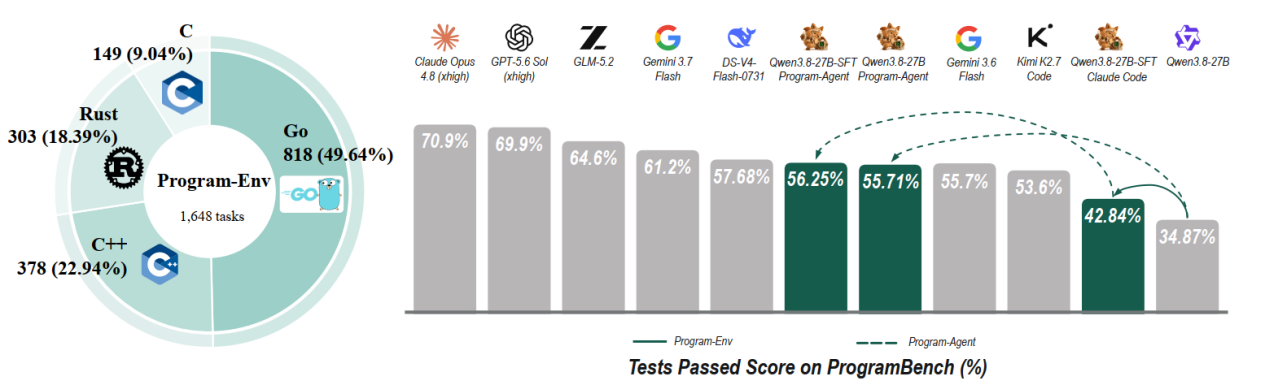
These scores come from controlled experiments with Qwen models. For Unisound, the joint research also connects directly to the development of its proprietary models. The related technologies have already been applied to U2-Flash development to strengthen capabilities including requirements discovery, long-horizon execution, and feedback-driven refinement.
04 Translating Research into Capabilities: Unlocking the Value of U2-Flash
ProgramGym combines automated construction of verifiable training environments with a connected workflow for analysis, implementation, and review. Together, these components address two challenges facing coding agents: how to obtain interactive, testable training tasks at scale, and how to preserve requirements, iterate continuously, and recover from failures during long-horizon development.
As a joint research partner, Unisound helped propose ProgramGym and has applied the related technologies to U2-Flash development. The findings on training environments and long-horizon workflows are being translated into model capabilities, providing technical support for requirements discovery, multi-step execution, and feedback-driven refinement in complex engineering development.
Try U2-Flash now:https://maas.unisound.com/models/u2-flash