Unisound Upgrades U2-Flash-1118 to Set a New Price Performance Benchmark Among China’s Leading Flash Models
In the agent era, a model’s value is increasingly measured by whether it can complete tasks efficiently and at lower cost, rather than simply answer questions. Foundation models for coding and agents that natively understand text and images, independently handle complex programming tasks, and execute reliably and correct their own errors over extended workflows are becoming the backbone of AI-native applications.
Today, we are officially releasing U2-Flash-1118, setting a new price-performance benchmark among China’s leading Flash models. A comprehensive upgrade to U2-Flash, the new model delivers systematic improvements in complex coding, autonomous agent execution, and multimodal understanding, while significantly reducing token consumption through more efficient execution. With stronger capabilities and lower costs, it makes every model call more valuable.
Put simply, U2-Flash-1118 can understand more information, independently complete more complex tasks, and accomplish the same work at a lower cost.
1 Leading Benchmark Results Place Overall Capabilities in the Top Tier
This combination of understanding, task completion, and efficiency has been validated across multiple established benchmarks.
The comparison covers nine representative benchmarks from China and abroad across three areas: multimodal perception, complex coding and agent execution, and scientific and mathematical reasoning. U2-Flash-1118 performed strongly across all nine, taking first place in two and second place in four.
Multimodal Perception with Balanced Text and Image Understanding and Strong Detail Recognition
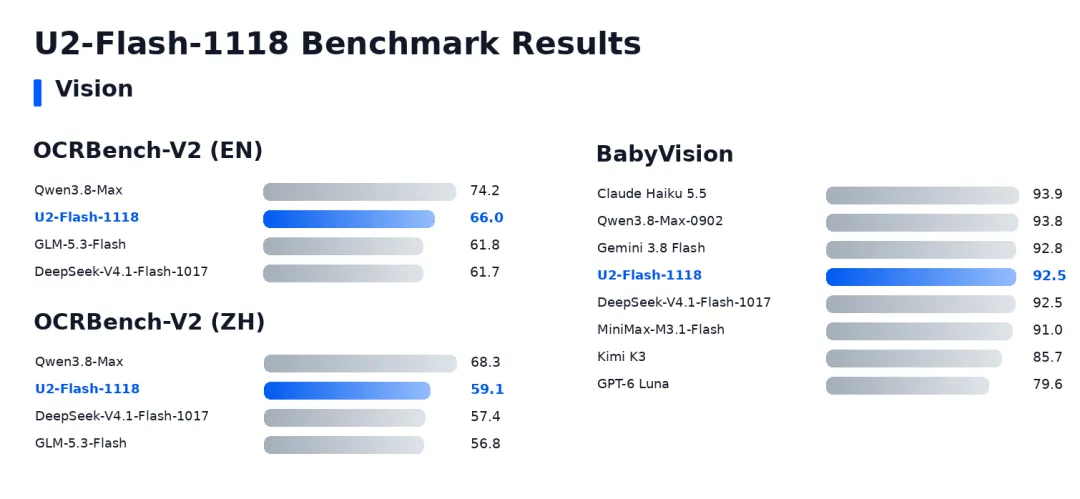
On the English and Chinese evaluations of OCRBench-V2, which assess complex text-and-image scenarios, the model scored 66.0 and 59.1, respectively, ranking second in both and outperforming GLM-5.3-Flash and DeepSeek-V4.1-Flash-1017. On BabyVision, which tests visual detail recognition and spatial understanding, U2-Flash-1118 scored 92.5, ahead of MiniMax-M3.1-Flash and GPT-6 Luna.
Complex Coding and Agent Execution with Stronger Engineering Capabilities for Large Repositories
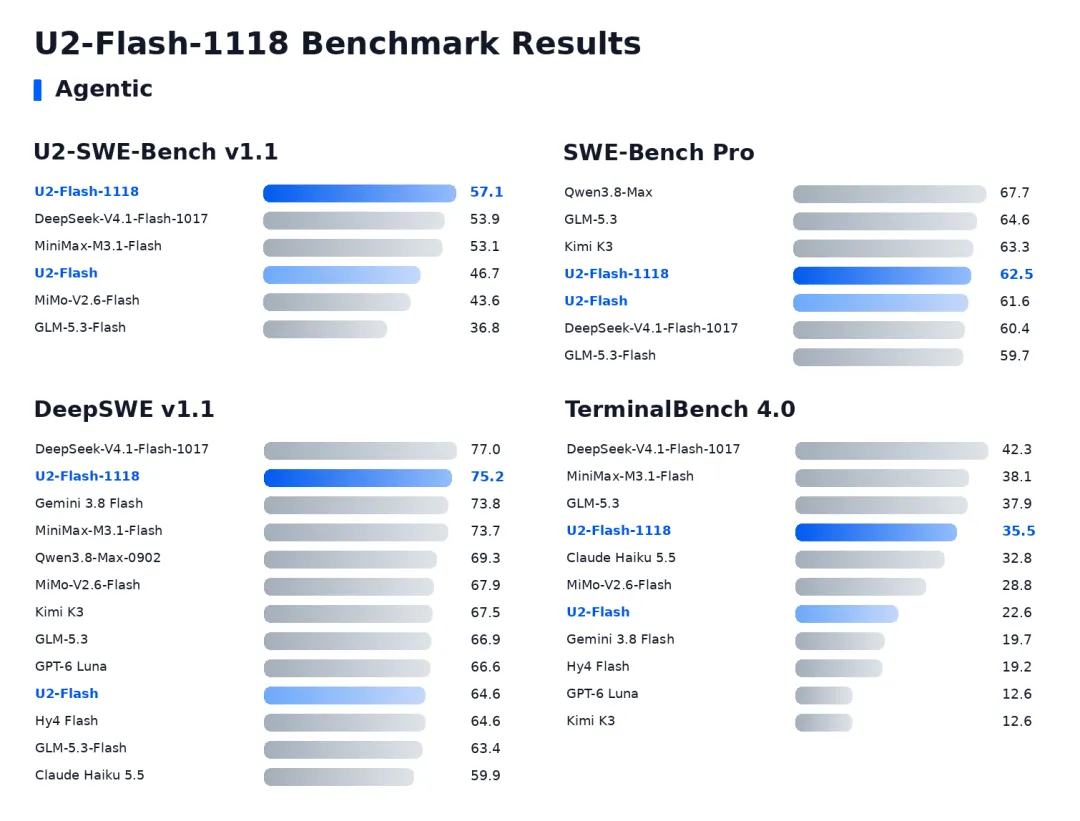
On U2-SWE-Bench v1.1, which focuses on repository understanding, issue diagnosis, and fixes, U2-Flash-1118 ranked first with a score of 57.1, ahead of DeepSeek-V4.1-Flash-1017 and MiniMax-M3.1-Flash. On DeepSWE v1.1, which assesses whether models can turn complex engineering requirements into verifiable code changes, it ranked second with 75.2, outperforming Gemini 3.8 Flash, MiniMax-M3.1-Flash, GPT-6 Luna, and Claude Haiku 5.5.
On SWE-Bench Pro, which evaluates issues from real-world code repositories, U2-Flash-1118 scored 62.5, above DeepSeek-V4.1-Flash-1017 and GLM-5.3-Flash. On TerminalBench 4.0, which tests task completion through multistep command-line operations, it scored 35.5, outperforming Claude Haiku 5.5, MiMo-V2.6-Flash, and Gemini 3.8 Flash. This represents a 12.9-point improvement over the previous version, the largest score gain across the four engineering benchmarks.
Scientific and Mathematical Reasoning with Leading Scores and Strong Competition Level Problem Solving
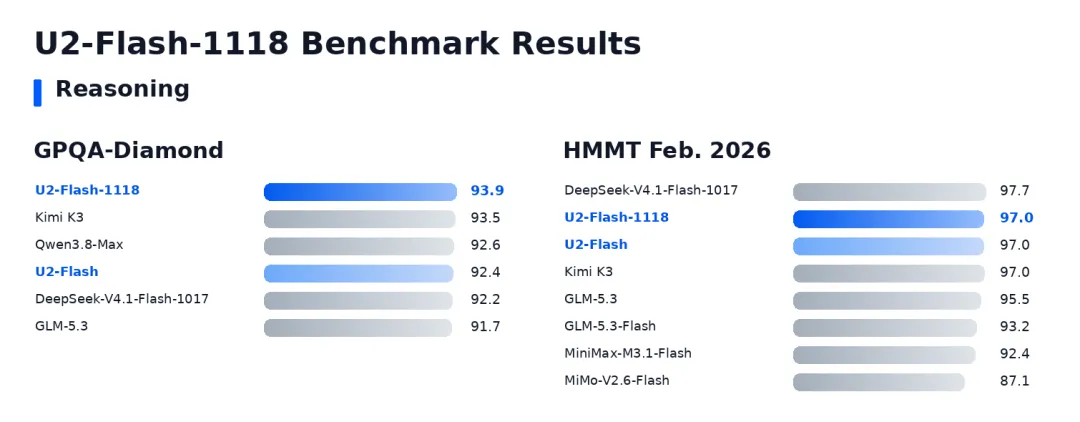
On GPQA-Diamond, a challenging scientific question-answering benchmark, U2-Flash-1118 ranked first with 93.9, ahead of Kimi K3 and Qwen3.8-Max and up 1.5 points from the previous version. On the HMMT Feb. 2026 competition mathematics benchmark, it scored 97.0, tying for second with the previous U2-Flash and Kimi K3, ahead of GLM-5.3 and MiniMax-M3.1-Flash.
2 Three Core Upgrades Take the Model from Understanding to Execution
The U2-Flash-1118 upgrade focuses on three areas.
First, multimodal understanding.
Unlike models that previously relied primarily on text and code inputs, U2-Flash-1118 adds native image understanding, enabling it to directly interpret UI screenshots, design mockups, charts, and document layouts. Developers can provide a screenshot of an interface or an error, and the model can use that visual information to understand the issue, locate the relevant code, and help make changes, reducing the need to describe visual information in words or make additional model calls.
Second, complex task execution.
When working with large repositories and multistep development tasks, models need to do more than understand requirements. They must plan autonomously, sustain execution, check results, and adjust when errors occur. Through training on real-world software engineering tasks, agent reinforcement learning, and recursive self-improvement (RSI), U2-Flash-1118 further strengthens its end-to-end capabilities, from requirements analysis and issue diagnosis to code changes and testing.
A particularly notable improvement is token efficiency.
In extended workflows, repeated exploration, unsuccessful retries, and redundant calls can create substantial additional costs. U2-Flash-1118 reduces this waste through execution trajectory optimization, dynamic budget allocation, and joint optimization with the agent harness. For the same tasks, total token consumption falls by approximately 37.0%, while model calls decrease by approximately 44.8%, further lowering the cost of completing complex work.
3 Three Coordinated System Upgrades Make the Difference on Difficult Tasks
U2-Flash-1118’s gains over U2-Flash do not come from a larger language model. The upgrade retains the original language backbone’s parameter count and adds only a 1-billion-parameter vision module. Most of the capability gains come from coordination across three areas in real-world engineering tasks.
First, enabling the model to learn from every execution.
Recursive self-improvement (RSI) is a key technology behind this upgrade. Traditional model iteration relies heavily on people identifying problems, designing training data, and optimizing the model through another round of training. U2-Flash-1118 goes further by incorporating execution feedback from real-world tasks into the improvement process.
When the model fails on a task, the system analyzes the underlying capability gaps and creates targeted training tasks. The model then explores solutions again, while the system verifies key actions. Through error-correction training and testing without additional prompts, the system identifies effective execution experience and incorporates it into the next training cycle.
For example, if the model repeatedly encounters cross-file dependency issues in a real project, the system can create similar tasks targeting that weakness, allowing the model to relearn and solve the problem. After training, the model must complete the tasks independently without additional prompts before that experience is accepted.
RSI optimizes not only the model, but also the task curriculum and the agent harness runtime framework, enabling continuous improvement in model capabilities, training tasks, and the execution system. All updates undergo independent testing and regression checks on existing capabilities to ensure that every improvement is backed by evidence.
Second, training on tasks that more closely reflect real-world development.
High-quality training data is essential to improving model capabilities. We have therefore built two core types of software engineering training tasks. The first uses issue fixes from real development histories, requiring the model to locate problems and make changes in existing repositories without introducing new errors. The second involves reproducing functionality based on reference programs, requiring the model to understand requirements through documentation and interactive exploration, then independently design and implement the functionality.
The first type develops the model’s ability to diagnose and solve problems in existing projects; the second builds its ability to move from understanding requirements to implementing features. Together, they cover key stages including issue diagnosis, requirements analysis, system design, code implementation, and result verification.
More importantly, each task comes with a fixed runtime environment and repeatable tests. Whether the model has actually solved a problem is determined by running and testing its work, rather than by how complete the generated code appears. Test results serve as valid training signals only after checks for correctness, stability, and error detection.
Finally, maximizing the value of every token.
Fixing a bug on the first attempt and reaching the same result through repeated attempts and revisions can consume very different numbers of tokens. During training, U2-Flash-1118 dynamically selects training data based on the model’s current error types, task success rate, and execution costs. This targets weaknesses in requirements exploration, cross-file changes, edge-case handling, and recovery from failures.
During execution, extended workflows are divided into three stages: analysis, implementation, and review. Separate sessions and structured handover materials pass along verified information, reducing repeated transfers of context and unproductive iterations.
The goal is to reduce duplicated work so that limited computing resources can be directed toward gathering new evidence, making effective changes, and verifying final results, rather than simply cutting token usage. Token savings must not come at the expense of task quality.
4 Practical Applications Turn Complex Ideas into Deliverables
From Spatial Concepts to 3D Films Bringing Creative Ideas to Life
U2-Flash-1118 drives Blender through code to handle space station modeling, materials, lighting, and animation, turning a spatial concept into an animated short film. In the space station example, the main structure comprises a central module, ring-shaped sections, support trusses, and solar panels, with details such as the cockpit, observation corridors, and hatches enriching the scene. The camera orbits and approaches the station from outside, travels through its interior, and transitions to a spacecraft departure and a distant look back, connecting visual storytelling across different scales. Unisound branding is integrated into the spacecraft exterior and console screens, bringing spatial design, cinematography, and brand presentation together in a complete work.
From Design Mockups to Interactive Websites Making Design Functional
U2-Flash-1118 turns static design mockups into interactive web pages, combining visual fidelity with functional development to deliver both the page design and its interactions. In the corporate website example, the model reproduces the layout, colors, and lighting effects while implementing interactions such as switching model categories and viewing product details. From the hero section with its blue lighting effects to the model lineup, partner section, and service access points, all modules share a consistent visual style and create a coherent browsing experience.
From Requirements to Infographics Making Complex Information Clear
When source materials are scattered and information is complex, U2-Harness starts with the user’s objective and breaks it down into an executable task sequence: understanding the content, gathering information and images, turning data into charts, and designing the layout. The result is a finished deliverable with clear priorities and integrated text and visuals. Output formats include editable PowerPoint presentations, Word documents, PDFs, and A1-size posters for project proposals, business reports, event promotion, and other uses.
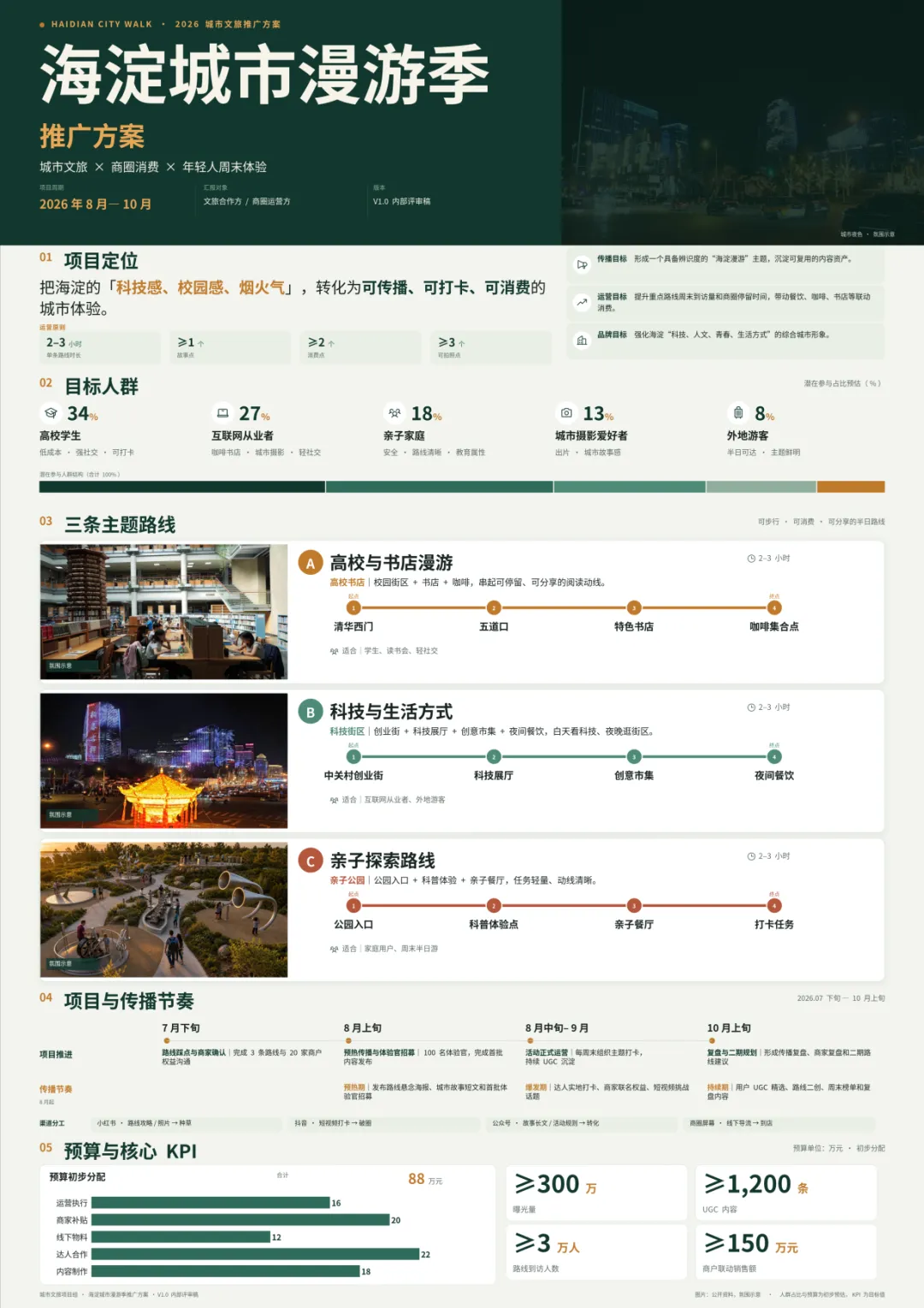
U2-Harness output example | Editable A1 infographic
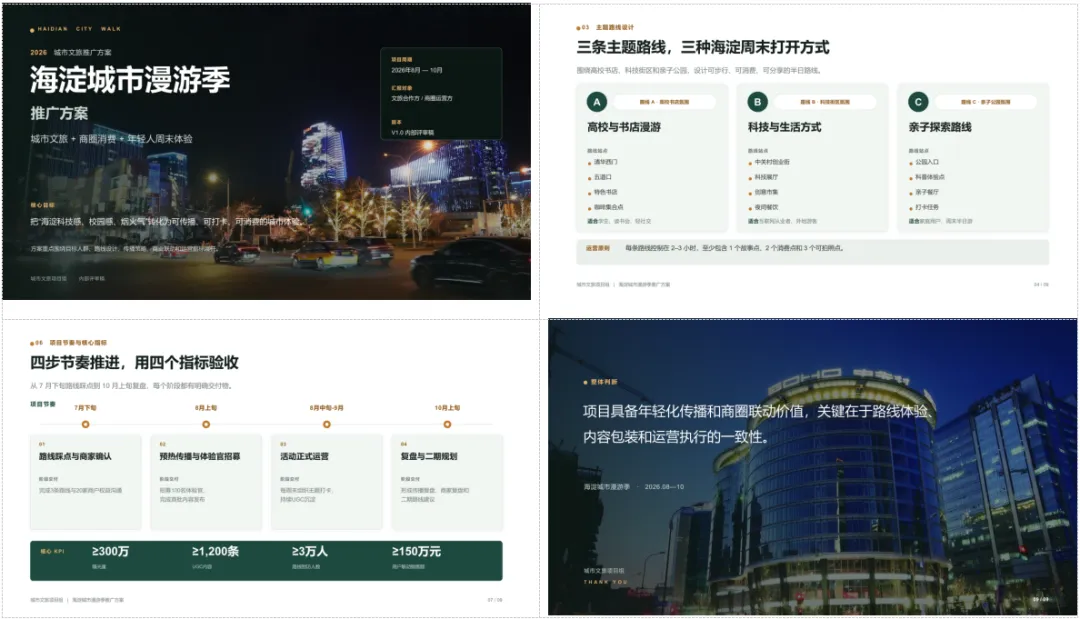
U2-Harness output example | PowerPoint presentation
From multimodal perception and long-horizon task execution to continuous improvement based on feedback, U2-Flash-1118 brings AI capabilities into complex real-world workflows, turning understanding into action and unlocking greater value from intelligence.
Try It Now
U2-Flash-1118 is now available on Unisound’s MaaS platform. Individual users, developers, and enterprises can explore the model’s capabilities on the platform, while developers and enterprises can also integrate it via API.
Limited-time offer at 40% off regular prices:
Input: CNY 0.6 per million tokens
Output: CNY 1.2 per million tokens
Cache hits: CNY 0.02 per million tokens
Click the link or scan the QR code below to try it now:
